
If you sell physical products, you’ve probably run into this decision: kraft paper or cardboard? Both get pitched as “green” packaging, both show up in eco-conscious unboxing videos, and both actually protect a product in transit. But they’re not interchangeable, and picking the wrong one can cost you either in shipping durability or in your brand’s sustainability claims.
This guide breaks down exactly how kraft paper and cardboard are made, how they compare on real environmental metrics, and which one makes sense depending on what you’re shipping.
What Is Kraft Paper?
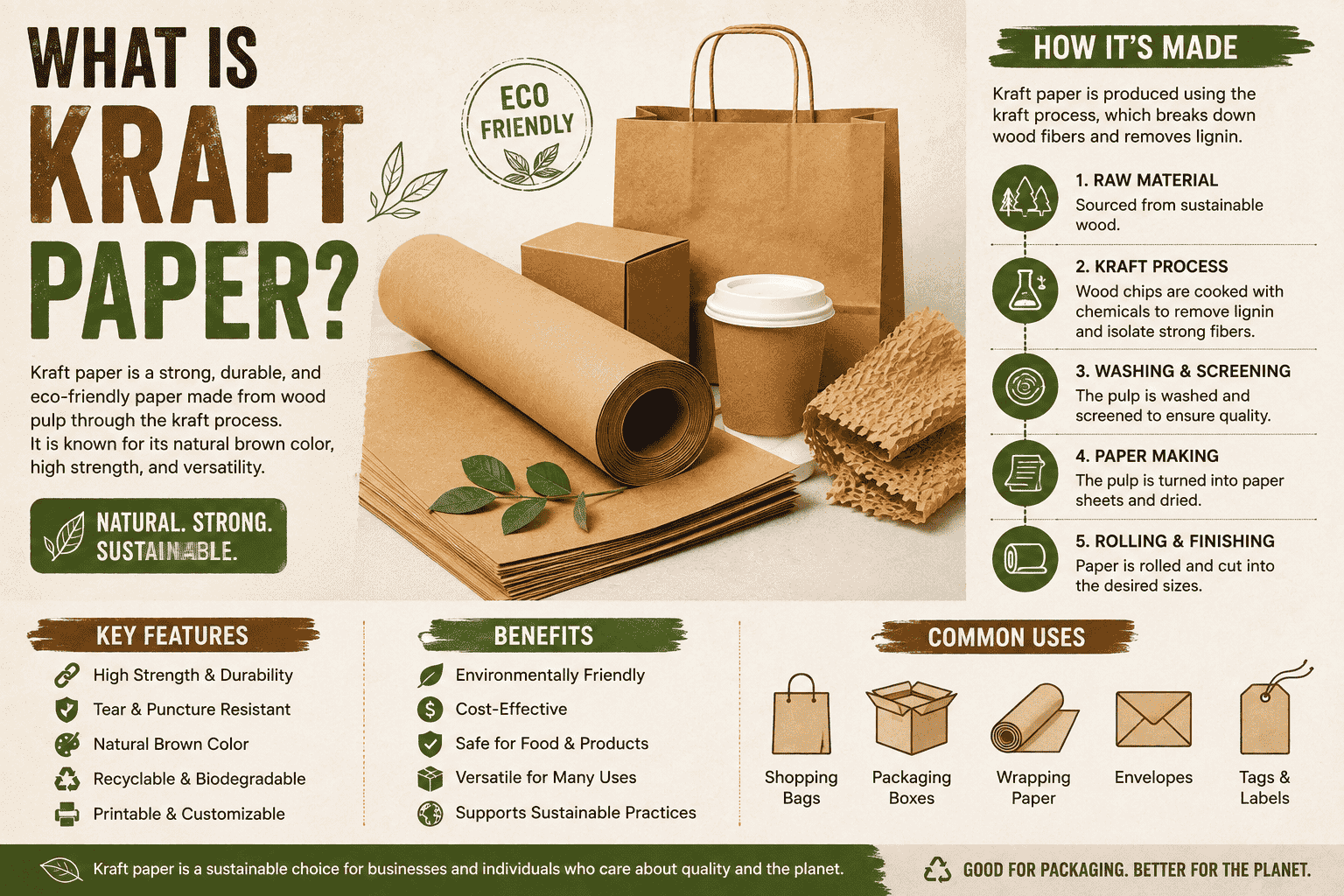
Kraft paper gets its name from the German word kraft, meaning “strength.” It’s produced using the kraft process — a chemical pulping method that breaks down wood fibers into pulp using minimal bleaching or none at all. That’s why kraft paper keeps its natural brown, slightly rough finish.
Because the fibers aren’t stripped of their natural lignin the way bleached paper is, kraft paper ends up stronger per layer than standard paper, even though it’s usually thinner and more flexible than cardboard. It’s commonly used for shipping mailers, paper bags, void fill, and interior packaging cushioning.
What Is Cardboard?
“Cardboard” is a catch-all term that usually refers to two different things:
- Paperboard — a single, dense layer of pressed paper pulp (think cereal boxes)
- Corrugated cardboard — multiple layers with a fluted (wavy) inner layer sandwiched between two flat liners, which is what most shipping boxes are made from
Cardboard is manufactured from wood pulp or recycled paper fiber, pressed into sheets, and — for corrugated board — run through a corrugator to create the fluted layer before being cut and glued into box form. The flutes are what give corrugated cardboard its shock absorption and stacking strength.
How They’re Made: The Real Difference
The production gap matters more than most comparisons let on.
Kraft paper generally goes through fewer processing stages: pulp to sheet, with little to no bleaching. Cardboard, particularly corrugated board, involves additional steps — pulping, pressing, corrugating, laminating layers together — which typically means more energy and adhesive use per unit, even when the raw material itself (recycled fiber) is sustainable.
This doesn’t automatically make kraft “better.” It means kraft paper tends to have a lower footprint per sheet, while cardboard trades that for structural strength you can’t get from a single kraft layer.
Environmental Comparison: Kraft Paper vs. Cardboard
| Factor | Kraft Paper | Cardboard (Corrugated) |
| Raw material | Virgin or recycled wood pulp, minimal bleaching | Virgin or recycled wood pulp, often multi-layer |
| Biodegradability | High — breaks down in weeks to months | High, but slower with coated/laminated finishes |
| Recyclability | Recyclable, though harder to recycle when coated or heavily printed | Recyclable up to ~7 times before fibers degrade |
| Compostable | Yes, in most home/industrial composting setups | Yes, if uncoated and free of plastic tape/labels |
| Production energy | Lower per sheet — fewer processing stages | Higher — corrugating and layering add energy use |
| Water use in production | Generally lower | Generally higher due to pulp processing volume |
| Best-case footprint | Uncoated, unbleached, undyed kraft | Recycled-content corrugated board, no lamination |
The honest takeaway: when both are in their purest, uncoated form, kraft paper usually has the lighter environmental footprint per unit of material. But that comparison isn’t the whole story, because kraft and cardboard aren’t actually solving the same packaging problem.
Durability and Strength
This is where cardboard pulls ahead, and it’s not close for certain use cases.
Kraft paper is strong for its weight, but it’s still a single layer. It’s well suited to lightweight mailers, gift wrap, paper bags, and interior padding. Ask it to protect something heavy, fragile, or being shipped long distances, and it won’t hold up the way corrugated cardboard will.
Corrugated cardboard’s fluted middle layer is specifically engineered for compression resistance and shock absorption. That’s why it’s the default for shipping boxes, electronics packaging, and anything stacked in a warehouse. More layers and higher flute grades (B-flute, C-flute, E-flute, etc.) mean more protection, but also more material and production energy.
In short: if you need structural protection, cardboard is doing a job kraft paper isn’t built for — the environmental comparison has to be weighed against whether the product even survives shipping.
Cost Comparison
Kraft paper is typically the cheaper material per unit, largely because it requires less processing and less material volume. That makes it attractive for brands using it as an outer wrap, mailer, or bag rather than a structural box.
Corrugated cardboard costs more to produce due to the extra manufacturing steps, but it often reduces indirect costs — fewer damaged shipments, fewer returns, and less product loss, which matters if you’re shipping anything breakable.
Branding and Customization
Kraft paper’s raw, unbleached look has become a design language of its own — it signals “natural,” “handmade,” or “sustainable” at a glance, and it takes stamped or minimalist printing well.
Cardboard offers more surface area and rigidity for full-color printing, die-cut windows, and structural branding elements (inserts, dividers, tuck-top designs). If your packaging is part of the unboxing experience, cardboard gives you more to work with.
Which One Should You Choose?
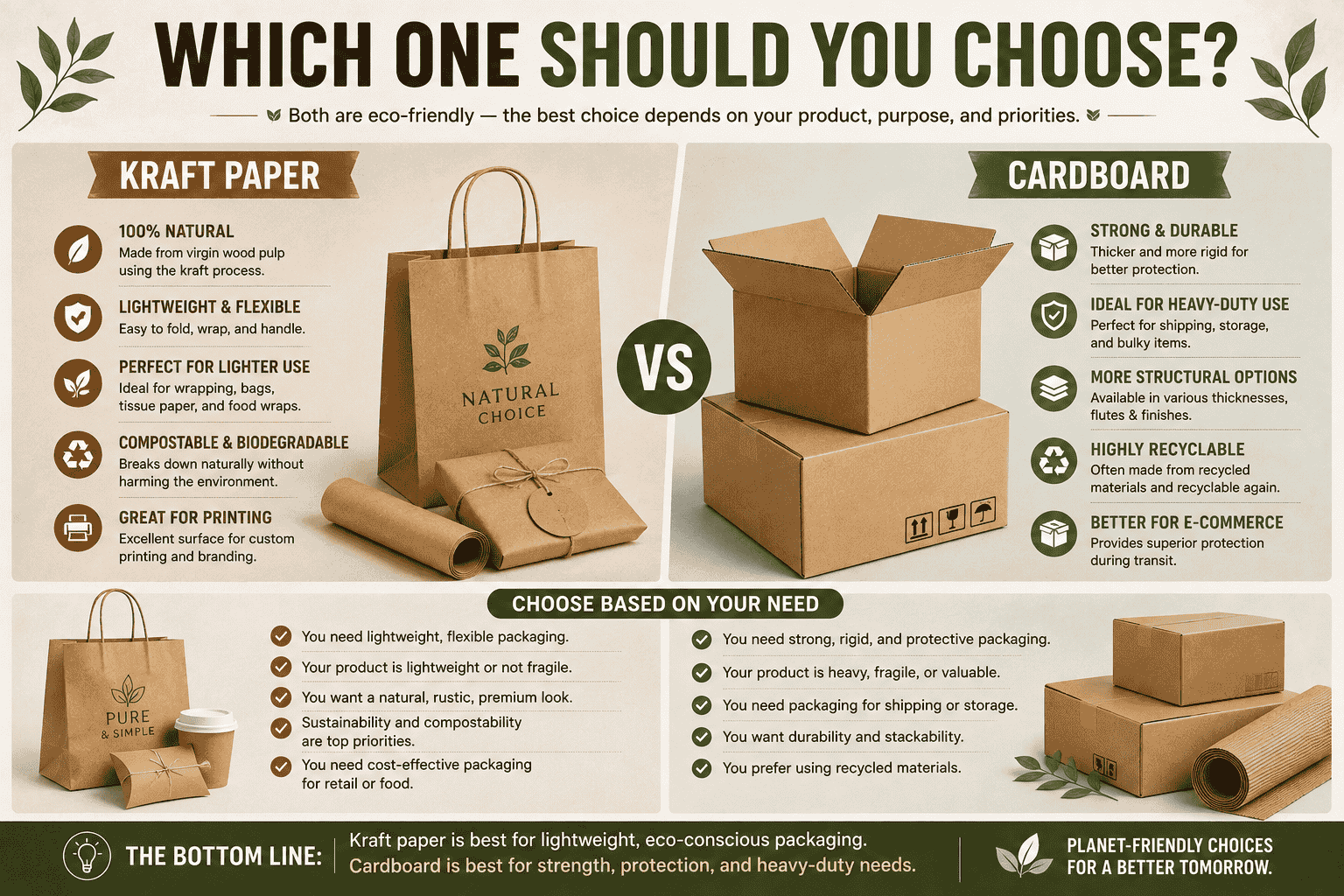
There’s no universal winner — it depends on what you’re shipping and what you’re optimizing for.
Choose kraft paper if:
- You’re shipping lightweight, non-fragile items
- You want the lowest-footprint option available and can accept less structural protection
- Your brand aesthetic leans natural, minimal, or handmade
- You’re using it as a mailer, bag, or interior wrap rather than a rigid outer box
Choose cardboard (corrugated) if:
- You’re shipping anything fragile, heavy, or over long distances
- Product protection directly affects your return/damage rate
- You need a rigid structure for retail display or stacking
- You’re using recycled-content board to keep the footprint down while keeping strength
The most sustainable answer for a lot of brands is actually both — a corrugated outer box for protection, paired with kraft paper void fill or kraft mailers for lighter-weight shipments, rather than treating it as an either/or decision.
Final Thoughts
Kraft paper and cardboard both earn their “eco-friendly” label, but they’re not competing for the same job. Kraft wins on lightness and lower processing footprint; cardboard wins on protection and durability. The right call comes down to what you’re shipping — and for a lot of brands, the real answer is using each one where it actually performs best.