
If you’ve ever mailed a contract, turned in a school application, or shipped a set of photos, chances are you’ve held a manila envelope in your hands. They’re one of those everyday products people use constantly but rarely think about — until they need to pick the right size, the right closure, or the right thickness for something important.
This guide breaks down everything worth knowing about manila envelopes: what they’re made of, the sizes and types available, how to pick the right one for your documents, and how to mail them without wasting postage. Whether you’re stocking an office supply closet or sourcing envelopes for your business, this should answer the questions that actually matter.
What Is a Manila Envelope?
A manila envelope is a sturdy, flat paper envelope typically used to mail or store documents, photos, and other flat items without folding them. They’re instantly recognizable by their tan or light-brown color and their noticeably thicker, more rigid paper compared to a standard letter envelope.
The name comes from Manila hemp, a fiber from the abaca plant native to the Philippines, which was historically used to make the strong, textured paper these envelopes were originally crafted from. Today, most manila envelopes are actually made from kraft paper or recycled pulp rather than true Manila hemp, but the name — and the tan color associated with it — has stuck around.
What Are Manila Envelopes Made Of?
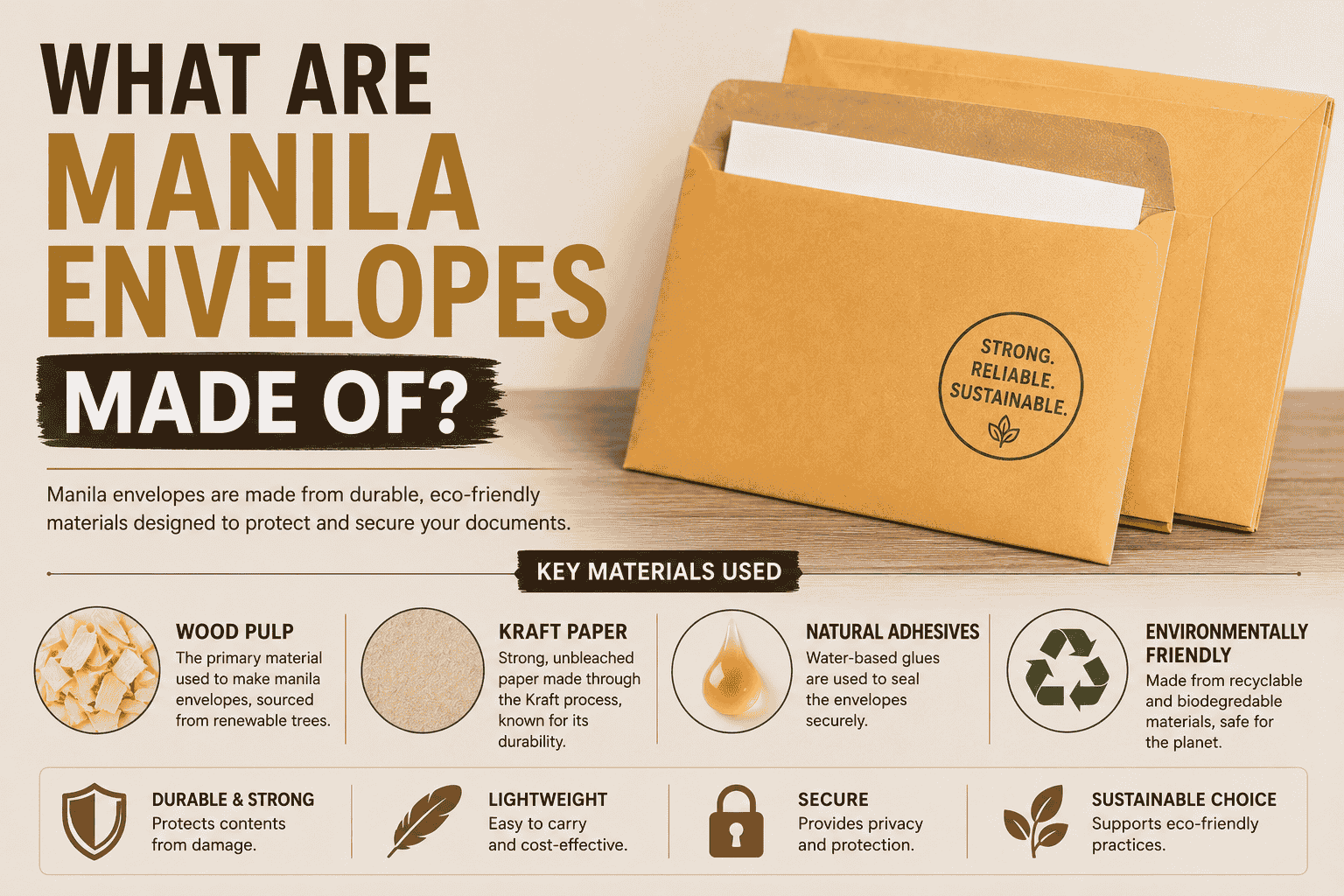
The strength of a manila envelope comes down to its paper stock. A few common options:
- Kraft paper — the most widely used material today, made from wood pulp through the kraft process, prized for its tear resistance.
- Recycled paper pulp — an eco-friendlier option, often slightly less rigid but still durable enough for everyday mailing.
- Manila hemp (abaca fiber) — the original material, now used mostly in specialty or premium-grade envelopes.
Paper weight matters here. Manila envelopes are usually measured in points (pt) or pounds, with common weights ranging from 28 lb to 40 lb for basic use, and heavier stocks (up to 80 lb or more) for items that need extra protection, like bulky documents or small products.
Manila Envelope Sizes Explained
Sizing is where most people get stuck, since manila envelopes aren’t sold with the same universal naming convention across every supplier. Here are the sizes you’ll run into most often in the US:
| Size Name | Dimensions | Common Use |
| Commercial / #10 | 4.125″ x 9.5″ | Letters, invoices, small mailers |
| Small Catalog | 6″ x 9″ | Brochures, small booklets |
| Catalog / A4 | 9″ x 12″ | Letter-size documents (unfolded) |
| Legal / Booklet | 9.5″ x 12.5″ | Legal-size paperwork |
| Large Catalog | 10″ x 13″ | Reports, small packages |
| Oversized | 12″ x 15.5″ and up | Posters, large document sets, artwork |
The rule of thumb: pick a size that lets standard letter or legal paper lie flat inside without folding. Folding not only looks unprofessional for business mailings, it can also damage documents like certificates, contracts, or photographs over time.
Types of Manila Envelopes
Beyond size, the style of envelope determines how it opens, how much it can hold, and how secure it is in transit.
Open-end envelopes — the flap opens on the short end. Common for mailing standard documents.
Open-side envelopes — the flap opens on the long side, often used when contents need to be inserted and removed frequently, like file folders.
Clasp envelopes — feature a metal clasp closure in addition to (or instead of) an adhesive flap, offering a reusable, tamper-evident seal. A go-to choice for internal office documents that get reopened repeatedly.
String-and-button (string-tie) envelopes — closed by wrapping a string around two paperboard buttons. These hold up well for repeated use and heavier contents, which is why they’re common in legal and archival settings.
Expansion (gusseted) envelopes — have an accordion-style side panel that lets the envelope expand, useful for thicker stacks of paper or small bound documents.
Window envelopes — include a clear or open window so an address printed on the document inside shows through, cutting down on manual labeling for high-volume mailings.
Where Manila Envelopes Are Used
Because they’re inexpensive, durable, and easy to customize, manila envelopes show up across almost every industry:
- Legal offices rely on them for case files, contracts, and court documents that need to stay flat and intact.
- Schools and universities use them for transcripts, applications, and diplomas.
- Healthcare providers use them for patient records and lab results that require confidentiality and durability.
- Businesses use them for invoices, proposals, reports, and internal mail routing.
- Individuals use them for mailing photos, resumes, tax documents, and anything else that shouldn’t be creased.
Manila vs. Kraft vs. White Envelopes: What’s the Difference?
People often use “manila” and “kraft” interchangeably, but there’s a real distinction worth knowing before you order in bulk.
| Feature | Manila Envelope | Kraft Envelope | White Envelope |
| Color | Tan / light brown | Brown (often darker) | White |
| Paper weight | Light-to-medium | Typically heavier/thicker | Light |
| Best for | General document mailing | Heavy-duty shipping, packages | Formal correspondence |
| Look/feel | Simple, professional | Rugged, industrial | Clean, polished |
| Typical cost | Lower | Slightly higher (heavier stock) | Moderate |
In short: manila is the everyday middle ground — sturdier than a standard letter envelope but lighter and cheaper than a full kraft shipping envelope. If you’re mailing paperwork, manila usually wins. If you’re shipping something with more bulk or weight, a heavier kraft envelope or padded mailer makes more sense.
How to Choose the Right Manila Envelope
A few practical questions to run through before ordering:
- What are you mailing? Loose papers need less structure than bound reports or photos.
- How many pages or items? If it’s more than a few sheets, consider an expansion envelope so the seal doesn’t stretch or tear.
- Does it need to be reopened often? Clasp or string-tie closures outlast adhesive flaps if the envelope will be used more than once.
- Is it going through the mail or handed off in person? Mailed envelopes benefit from a reliable self-seal or gummed flap; internal documents can get away with a simple clasp.
- Do you need branding on it? Custom-printed manila envelopes with a logo are a low-cost way to make outgoing mail look more professional — something worth considering for client-facing paperwork.
How to Address and Mail a Manila Envelope
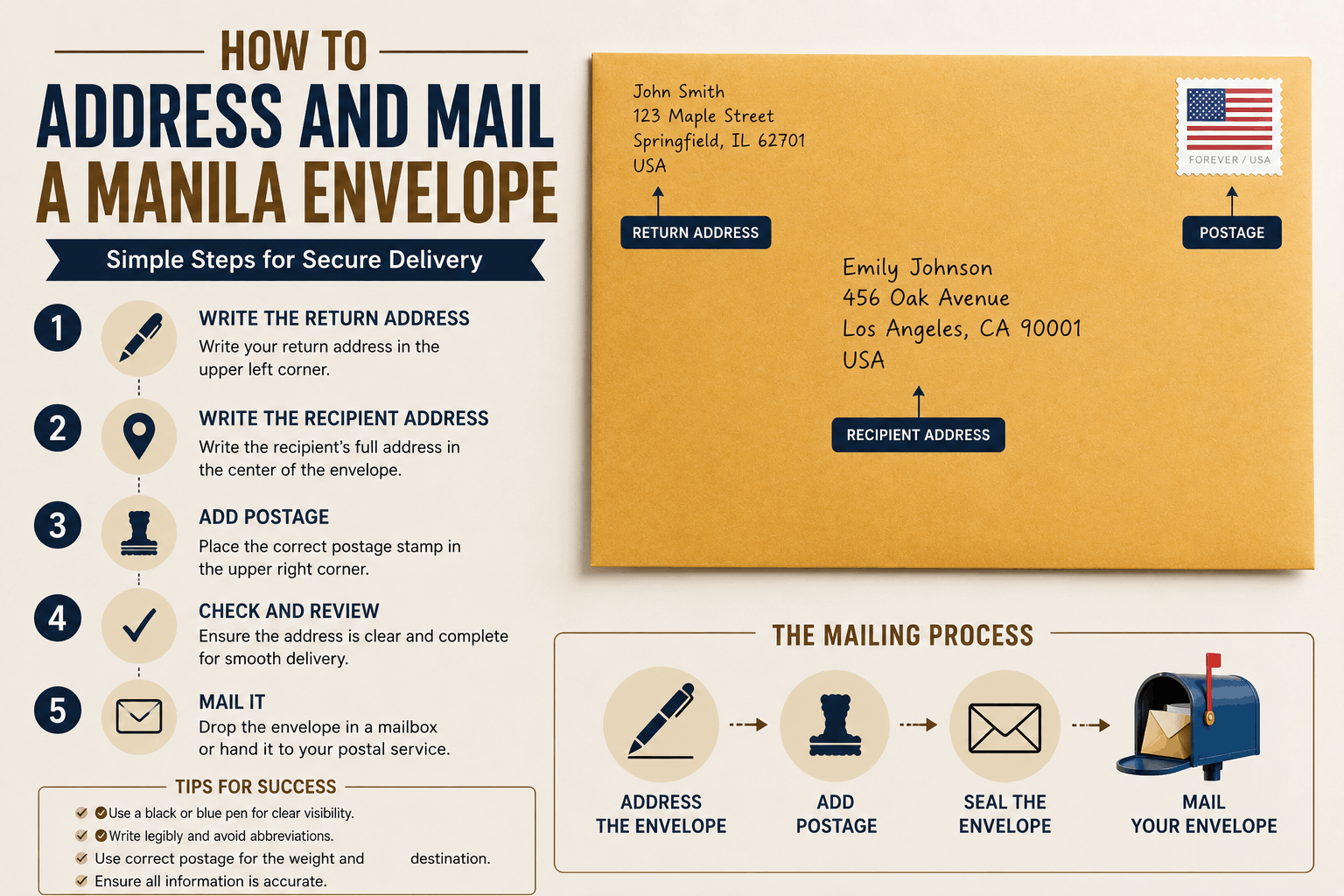
Manila envelopes are addressed the same way as any other mail piece: recipient’s name and address centered or left-aligned in the lower two-thirds of the envelope, and your return address in the upper left corner.
How many stamps does a manila envelope need? This depends on weight, not size. As a general guide:
- Most manila envelopes fall into the USPS “large envelope” or “flat” mail category once they exceed standard letter dimensions.
- A large envelope up to 1 oz typically needs one large-envelope-rate stamp; each additional ounce adds a small surcharge.
- Heavier contents (multiple pages, photos, cardstock) push the weight up quickly — it’s worth weighing anything over a few sheets rather than guessing, since postage rates change periodically and USPS enforces them strictly.
If in doubt, a quick weigh-in at a post office counter avoids the envelope getting returned for insufficient postage.
Custom Printed Manila Envelopes
For businesses that send a high volume of mail — law firms, medical offices, real estate agencies — custom printing is worth considering. Adding a logo, return address, or even a subtle brand color to the flap turns a purely functional envelope into a small, low-cost branding touchpoint. It’s a detail clients notice more often than businesses expect.
Final Thoughts
Manila envelopes have stuck around for over a century for a simple reason: they’re cheap, strong, and get the job done without much fuss. The trick is matching the size, weight, and closure style to what you’re actually sending — get that right, and you’ll rarely think about them again, which is exactly the point.
Looking for manila envelopes in bulk, custom sizes, or with your branding printed on them? [Your Brand Name] can help you source the right fit for your business — reach out and we’ll help you figure out exactly what you need.