The packaging you choose today isn’t just a box or a bag. It’s a signal — to buyers, retailers, regulators, and even the planet — about what kind of business you run.
But packaging technology is moving fast. What was cutting-edge three years ago is now standard. And what’s emerging right now will define which brands win shelf space and repeat customers over the next decade.
In this guide, we break down 8 packaging technologies that are genuinely reshaping the industry in 2025 — what they are, how businesses are using them, and whether they’re right for your products.
1. Automated Packaging Systems

Automation isn’t new, but the scope of what’s possible in 2025 has expanded dramatically — and the price of entry has dropped just as dramatically.
Modern automated packaging systems go far beyond fill-and-seal machines. Today’s systems handle picking, cartoning, labeling, quality control, and palletizing — all within a single integrated line. For businesses running high volumes of products, this translates directly into lower cost-per-unit and significantly faster throughput.
What’s Actually Available Now
Fill & Seal Machines — Ideal for liquid products like sauces, oils, and beverages. These machines fill each container in a precise, equal measure and seal it automatically, removing the inconsistency you’d get with manual filling.
Cartoning Machines — These take flat-pack cartons, erect them, load product inside, and seal them — often at speeds that would require 10–15 manual workers to match. The key advantage isn’t just speed; it’s consistency. Every carton comes out identical.
Automated Film Wrapping — Common in food and produce packaging. These machines wrap, cut, and seal polythene or shrink film around products with minimal waste.
Recycling Automation — This one is often overlooked. If you’re generating large volumes of cardboard, kraft, or corrugated waste, automated shredding and baling systems can process and recycle that material on-site, reducing waste disposal costs.
2. Smart Packaging with IoT Sensors
This is where packaging crosses into technology that most brands haven’t fully caught up with yet — which means there’s real competitive advantage available to early movers.
Smart packaging refers to packaging that communicates. It uses embedded sensors, QR codes, NFC chips, or RFID tags to relay information about a product’s condition, location, or authenticity — in real time.
How It’s Being Used
Temperature Monitoring — Pharmaceutical and food companies use sensor-embedded packaging to track whether products stayed within safe temperature ranges during shipping. If a shipment of vaccines or specialty foods was exposed to damaging temperatures, the packaging signals the issue before the product is even opened.
Freshness Indicators — Some smart packaging includes chemical sensors that change color when food inside begins to spoil. This isn’t science fiction — it’s already in use by several food brands in Europe and is making its way into US retail.
Anti-Counterfeit Tracking — Luxury goods brands, pharmaceutical companies, and electronics manufacturers embed NFC or RFID chips that allow buyers to instantly verify product authenticity with a phone tap. This alone has driven significant adoption among high-value product categories.
Is it right for you? Smart packaging has the highest ROI for perishable goods, pharmaceuticals, luxury items, and products with complex supply chains. For simpler consumer goods, QR codes that connect to product stories or loyalty programs are a cost-effective entry point.
3. 3D Printing in Packaging Design
3D printing has quietly become one of the most practical tools available to packaging designers and brands — particularly for prototyping and short-run custom packaging.
The traditional path to a custom box design involves weeks of back-and-forth with manufacturers, costly die tooling, and minimum order quantities that don’t make sense for new products or limited editions. 3D printing bypasses much of that.
Where 3D Printing Adds Real Value
Rapid Prototyping — Before committing to a full production run, brands can 3D print physical packaging prototypes in days. This allows product teams to evaluate the look, feel, and structure of packaging in the real world before a single dollar is spent on tooling.
Custom Inserts — 3D printing excels at creating fitted inserts for rigid boxes — the kind that hold fragile or irregularly shaped products securely. Custom inserts created this way are more precise than foam alternatives and can be produced in small quantities without setup fees.
Marketing Campaigns — PepsiCo demonstrated this well. Their collaboration with Marvel Studios for the Black Panther premiere involved 3D-printed mask overlays for Pepsi cans — something that simply wouldn’t have been feasible with traditional manufacturing at that timeline and budget.
4. Tamper-Evident Packaging Technologies
Consumer trust is hard to build and easy to destroy. Tamper-evident packaging is one of the most direct ways to communicate product integrity to your buyers — and in regulated industries, it’s not optional.
The FDA mandates tamper-resistant packaging for certain over-the-counter pharmaceutical products. But beyond regulatory compliance, tamper-evident features have become a trust signal that buyers in food, supplements, and cosmetics increasingly expect.
The Main Options
Blister Packaging — The clear plastic blisters backed by aluminum foil that you see with tablets and capsules. Once the foil is punctured, it can’t be resealed — making tampering immediately obvious. It’s also cost-effective for high-volume pharmaceutical products.
Pressure-Sensitive Foam Seals — Placed under bottle caps, these foam discs adhere to the bottle opening and can’t be removed without tearing. Common in supplements, vitamins, and sauces.
Tamper-Evident Band Caps — The plastic ring at the base of a bottle cap that breaks when the cap is first opened. You’ll recognize this from most bottled beverages and liquid medicines. Simple, highly visible, and nearly universally understood by consumers.
Induction Seals — Used heavily in the food and pharmaceutical industries. The foil liner is bonded to the container opening using electromagnetic induction — a process that produces a seal that’s impossible to replicate without specialized equipment.
5. Nanotechnology in Packaging Materials
Nanotechnology might sound like it belongs in a physics lab rather than a packaging warehouse, but it’s already embedded in materials you may be using without realizing it.
At the nano scale, materials take on properties they don’t have at larger scales — and packaging manufacturers have been engineering this to solve real problems like moisture barrier performance, microbial resistance, and material strength.
The Three Nanotechnologies Worth Knowing
Nanocellulose — A plant-derived material that’s been modified at the nanoscale to become denser, stronger, and impermeable to water. Despite performing like plastic in terms of barrier properties, it’s fully biodegradable and compostable. It’s one of the most promising material advances in sustainable packaging right now.
Nano Starch — Standard starch films have always been appealing as a sustainable packaging material, but they had limitations in durability and moisture resistance. Nano starch addresses both, resulting in films that are biodegradable, flexible, thermally stable, and water-resistant.
Carbon Nanotubes — These cylindrical carbon structures have exceptional mechanical strength and antimicrobial properties. In packaging, they’re used in materials that need to prevent bacterial growth — a significant application in food and medical packaging. They’re also being incorporated into oxygen sensors for modified atmosphere packaging.
6. Modified Atmosphere Packaging (MAP)
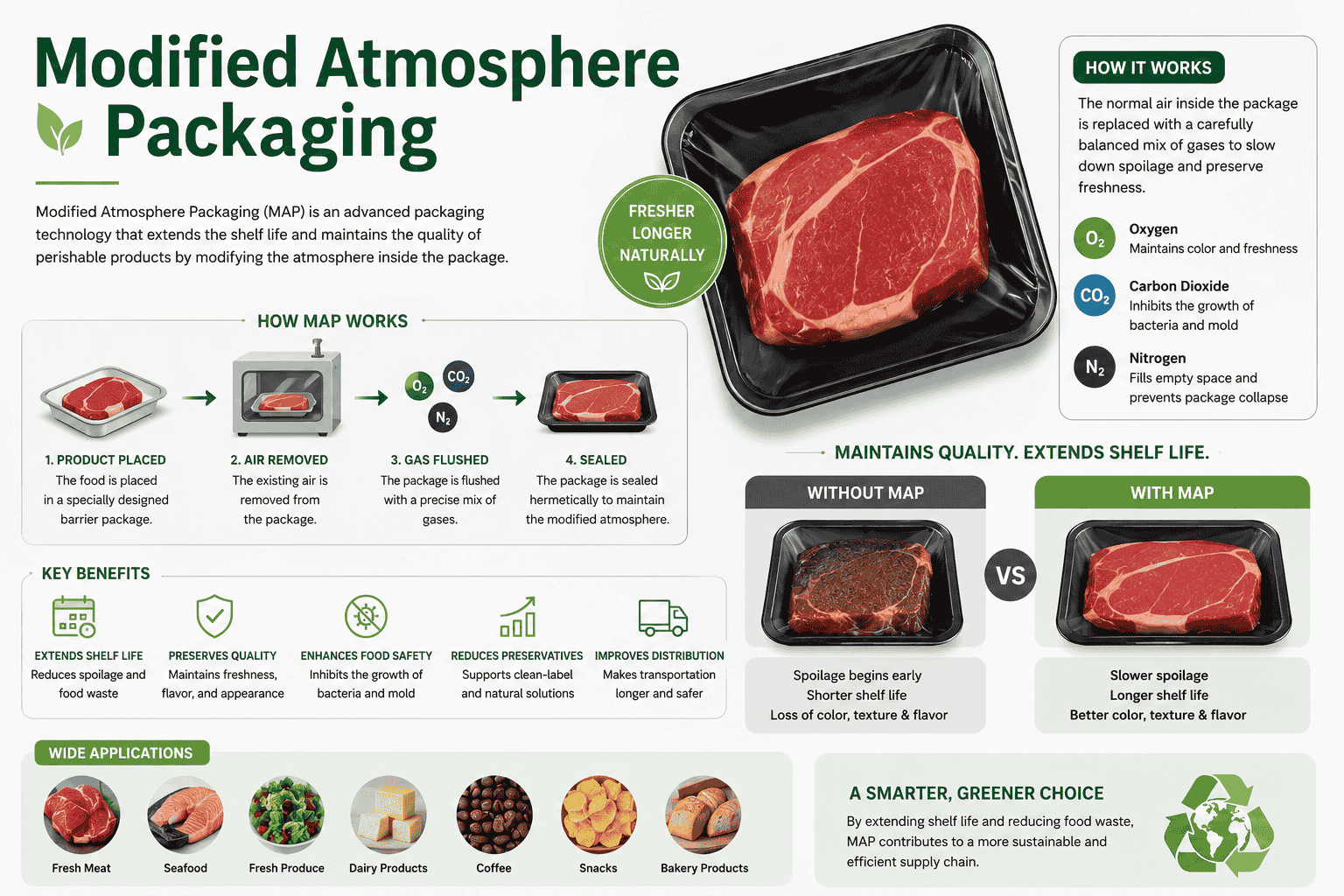
If you sell fresh produce, meat, seafood, or specialty cheeses, Modified Atmosphere Packaging might be the most impactful technology on this list for your business.
MAP works by replacing the air inside a package with a custom gas mixture — typically some combination of nitrogen, carbon dioxide, and oxygen — that slows down the natural spoilage and oxidation processes. The result is dramatically extended shelf life without the need for preservatives.
How MAP Works in Practice
The specific gas ratio used inside the package depends on the product. Leafy vegetables, for example, need a different atmosphere than red meat. Packaging equipment measures and injects the correct mix during sealing.
The benefits are measurable:
- Leafy greens that might last 5–7 days in standard packaging can last 10–14 days in MAP
- Red meat retains its color and freshness significantly longer
- Bakery products experience slower mold growth
7. Edible and Dissolvable Packaging
This category tends to get treated as a novelty, but the market data tells a different story. Edible packaging was valued at approximately $711 million in 2023 and is projected to reach nearly $1.2 billion by 2032.
What’s driving that growth is straightforward: consumers — particularly younger buyers — actively seek out brands that reduce plastic waste. Edible or dissolvable packaging is the most dramatic possible statement on sustainability.
The Technology Behind It
Starch-Based Films — Made from plant starch, these films wrap fresh produce and food items the same way plastic wrap does, but they’re fully edible and compostable. The material degrades naturally without releasing toxins.
Seaweed-Based Packaging — Seaweed combined with calcium chloride can be formed into thin, flexible films or even bottle-like containers. The resulting material is edible, biodegradable within weeks, and requires no petroleum inputs to produce. Ooho — a startup that made waves with their seaweed water pods — pioneered commercial use of this approach.
Pasta-Based Straws — A practical answer to the soggy paper straw problem. Pasta straws are rigid enough to function properly, biodegradable, and edible — addressing both the sustainability concern and the user experience complaint in one product.
Final Thoughts
Packaging technology has moved well beyond “what keeps products from breaking in transit.” Today it’s a tool for extending product life, building consumer trust, meeting regulatory requirements, reducing environmental impact, and differentiating your brand on a shelf full of competitors.
The businesses that will win in the next five years aren’t necessarily those with the biggest budgets — they’re the ones that stay informed, make deliberate choices about which technologies serve their specific products and customers, and execute those choices with quality materials and consistent design.