
Every box, bag, label, and insert starts as a decision about paper. Get the grade right, and your packaging holds its shape, prints cleanly, and survives shipping. Get it wrong, and you end up with soggy mailers, cracked folds, or a print job that looks washed out. This guide breaks down what paper grades actually mean, how the weight systems work, and which grade fits which packaging job.
What Is a Paper Grade?
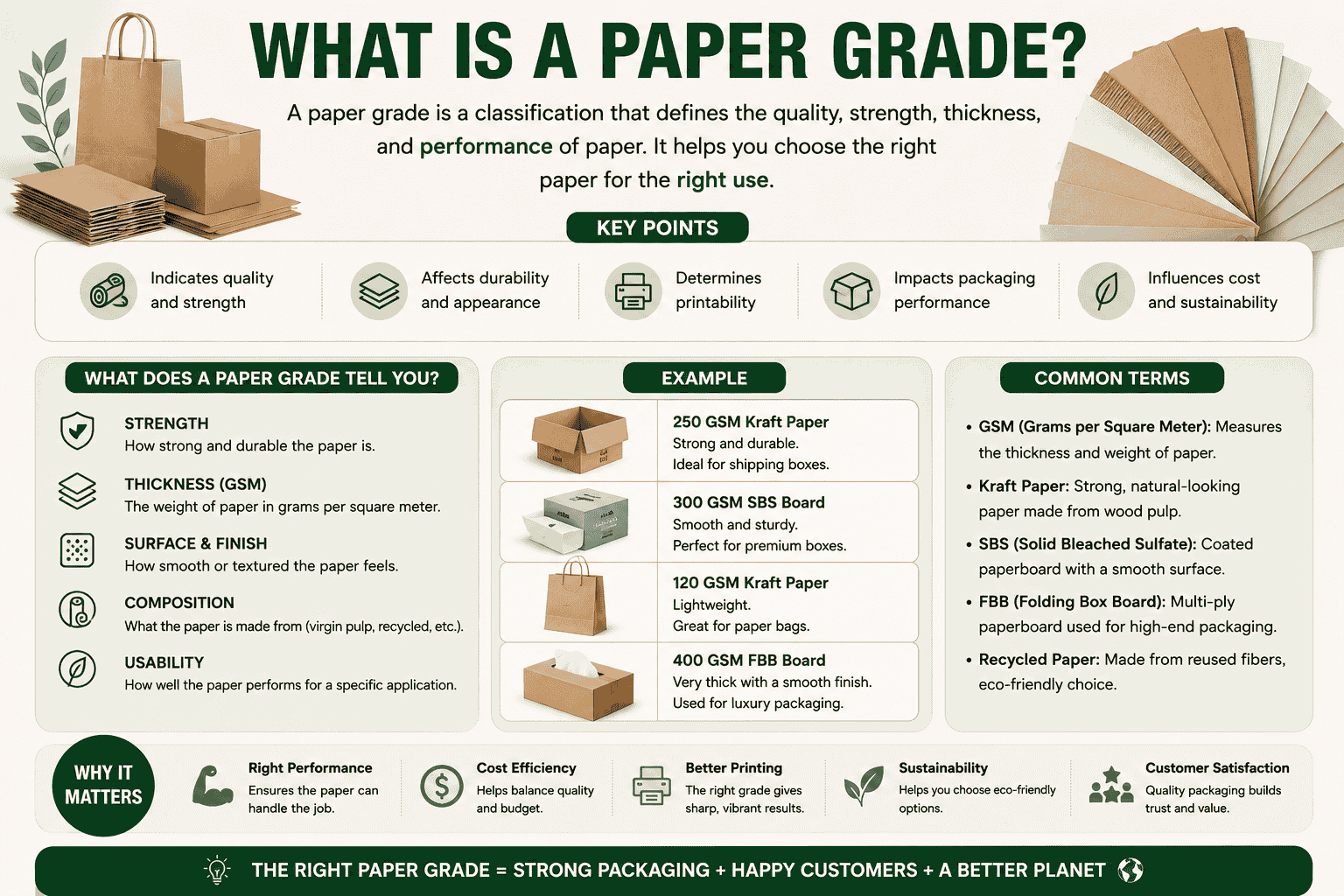
A paper grade is a classification that groups paper by its fiber content, weight, finish, and intended use. Two sheets can look similar but perform completely differently once you know their grade — one might be built for crisp offset printing, the other for holding up under moisture or repeated handling.
Paper grades are generally sorted along three lines:
- Weight — how heavy or thick the sheet is (measured in GSM, lb, or points)
- Fiber and bleaching — virgin fiber vs. recycled, bleached vs. unbleached
- Finish — coated, uncoated, matte, gloss, or laminated
Understanding all three is what lets you actually compare two paper options instead of guessing based on price alone.
GSM, Pounds, and Points: Why Paper Weight Is Confusing
This is where most people get stuck, and it’s worth untangling before anything else.
GSM (grams per square meter) is the international standard. It measures the weight of one square meter of paper, full stop, regardless of what category the paper belongs to. This makes it the easiest system for direct comparison, which is why most packaging suppliers outside the US quote in GSM.
Pounds (lb), the US system, measures the weight of 500 sheets at that paper category’s standard factory size — and this is the part that trips people up. Bond paper is cut from 17″×22″ sheets, text/offset paper from 25″×38″ sheets, and cover stock from 20″×26″ sheets. Because the base sheet size is different for each category, an 80 lb text paper and an 80 lb cover paper are not the same thickness at all. 80lb text works out to roughly 118 GSM, while 80lb cover is closer to 216 GSM — nearly double.
Points (pt) measure thickness rather than weight, with one point equal to 1/1000 of an inch. This system shows up mostly on cardstock, business cards, and packaging board, where rigidity matters more than raw weight. A 14pt cardstock, for example, comes out to roughly 306 GSM.
The practical takeaway: when a supplier quotes you a paper by weight, always ask for the GSM and confirm the paper category. “100 lb” alone tells you almost nothing.
Quick Reference: Common Paper Weights
| Use Case | Typical Weight | Approx. GSM |
| Standard copy paper | 20 lb bond | 75 GSM |
| Letterhead | 24–32 lb bond | 90–120 GSM |
| Flyers / brochures | 80–100 lb text | 118–148 GSM |
| Magazine pages | 45–70 lb | 68–105 GSM |
| Postcards | 90–110 lb cover | 244–300 GSM |
| Standard cardstock | 80 lb cover | 216 GSM |
| Hang tags | — | 150–250 GSM |
| Folding cartons | 90–130 lb cover | 250–350 GSM |
| Premium rigid boxes | 150 lb cover+ | 400+ GSM |
The Two Broad Families: Text and Cover
Before getting into packaging-specific grades, it helps to know the base split that most paper falls into.
Text (or Book) grade covers lighter, more flexible stocks — bond, offset, ledger, writing paper. It folds and rolls easily and is the go-to for flyers, letterheads, and interior book pages. It’s not built to stand on its own as packaging.
Cover (or Card) grade is thicker and stiffer, and includes Bristol, index, tag, and cardstock. It needs to be scored before folding and holds a crease well, which is exactly what packaging structures depend on. Anything from a hang tag to a folding carton starts life as a cover-grade paperboard.
Paper Grades That Actually Matter for Packaging
Once you move past office and print paper into packaging-grade material, a different set of terms takes over. These are the ones worth knowing if you’re specifying boxes, bags, or inserts.
Solid Bleached Sulfate (SBS) is made from 100% virgin fiber and bleached to a bright, uniform white on both sides. It takes embossing, foil stamping, and UV coating cleanly, which is why it shows up constantly in cosmetics, perfume, and premium food packaging. The tradeoff is cost — SBS sits at the expensive end of the paperboard range — and it doesn’t hold up well against moisture or humidity.
Solid Unbleached Sulfate (SUS), commonly sold as natural kraft, keeps the fiber unbleached, giving it that recognizable brown, rustic look. It trades some of SBS’s polish for real strength — better tear resistance and tensile strength — and it costs less. This is the grade behind most kraft mailer boxes and eco-positioned retail packaging.
Coated Unbleached Kraft (CUK) starts as the same unbleached fiber as SUS but adds a coating, usually polyethylene, on top. That coating buys water and grease resistance, which makes CUK the better call for anything that might get damp in transit or sit near food.
Corrugated linerboard and medium aren’t a single sheet at all — they’re the flat facing sheets and the fluted middle layer that get glued together to make corrugated board. The flute type (A, B, C, E, or double/triple wall) determines how much cushioning and stacking strength the final box has, independent of what paper grade the liners themselves are.
Recycled paperboard, made from post-consumer or repurposed fiber, has closed a lot of the quality gap with virgin stock in recent years. Modern recycled options run smoother and more versatile than older recycled pulp, and can be coated, uncoated, or blended with virgin fibers, which makes it a workable choice for brands leading with a sustainability message without sacrificing print quality.
How to Choose the Right Paper Grade
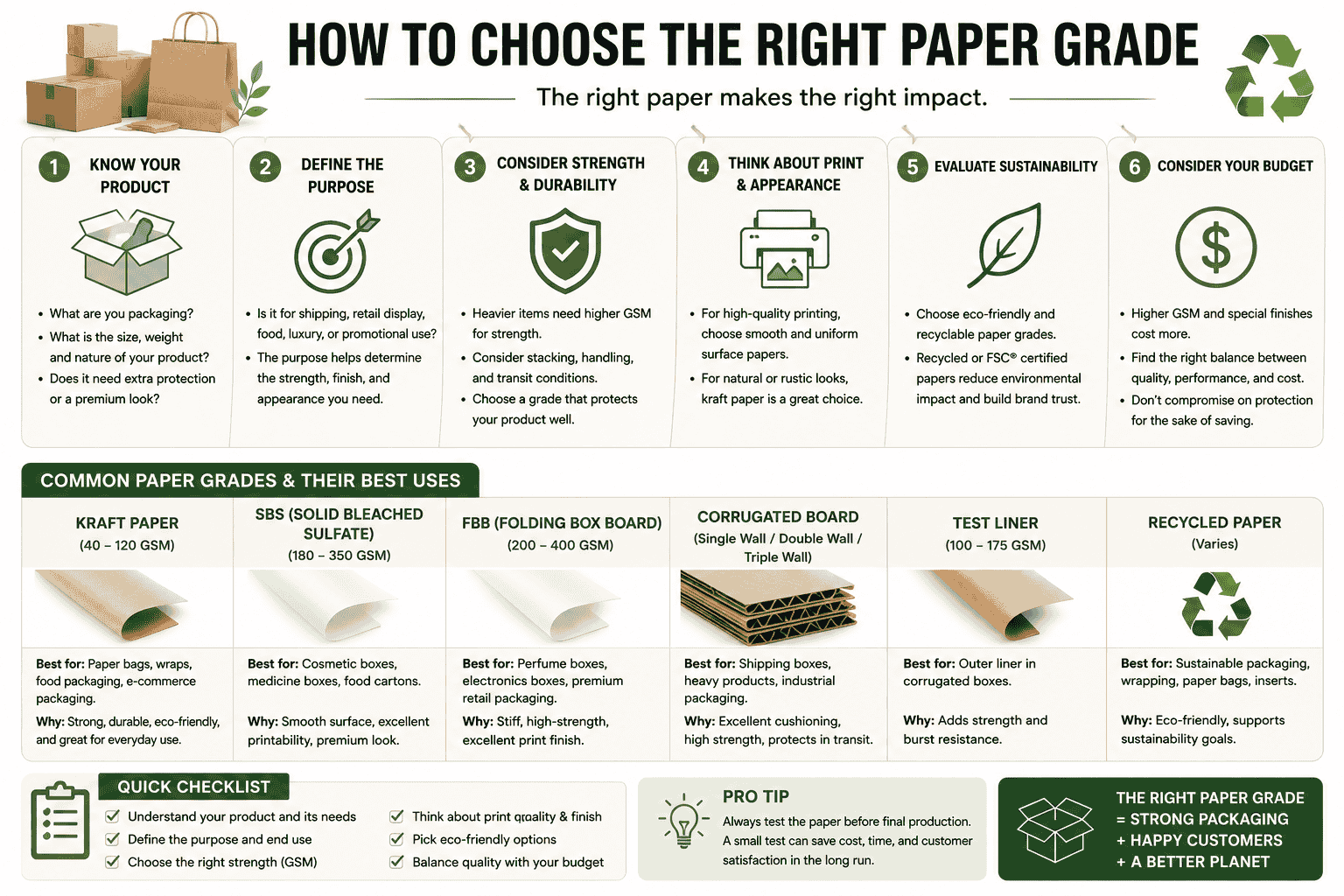
Match the grade to the job, not the other way around. A few starting points:
For rigid or luxury boxes (skincare, jewelry, electronics): SBS or a high-GSM coated cover stock, generally 300 GSM and up, gives you the crisp print surface and structural stiffness that premium unboxing depends on.
For folding cartons (retail boxes, food cartons): 250–350 GSM cover stock is the standard working range — heavy enough to hold its fold, light enough to keep shipping costs sane.
For kraft mailers and shipping boxes: SUS or corrugated board with kraft liners. Prioritize tear resistance and stacking strength over finish.
For anything food-adjacent or exposed to moisture: CUK or a food-grade coated stock. The polyethylene or wax layer is what actually keeps grease and moisture from soaking through, not the base paper weight.
For labels and hang tags: 150–250 GSM gives you enough body to look premium without becoming stiff enough to crack when applied to a curved surface.
For inserts, tissue, and interior print pieces: lighter text-weight stock, 80–120 GSM, is plenty since these pieces aren’t carrying structural weight.
A few other factors worth weighing alongside GSM: how the box or bag will be handled (one-way shipping vs. retail shelf display), whether it needs to survive humidity or refrigeration, and whether the finish needs to support foil stamping or embossing, since not every grade holds those techniques equally well.
Paper Grades and Sustainability
Weight and environmental impact move together more often than people expect. Producing 100 sheets of 110 lb cardstock uses roughly four times the fiber that 20 lb copy paper does, and heavier stock generally costs more to manufacture, ship, and recycle. That doesn’t mean lighter is always the better environmental choice — a heavier sheet that survives shipping without damage can prevent a reorder and a second production run, which has its own footprint. The more useful rule is to pick the lightest grade that still does the job reliably, and to look for recycled content or certified sourcing on top of that, rather than treating weight as a stand-in for sustainability on its own.