
If you’ve been sourcing packaging for more than a week, you’ve probably hit the same wall: every supplier throws around the terms “rigid box” and “folding carton” like you already know the difference. Most buyers don’t — and honestly, there’s no reason you should, unless packaging is your full-time job.
Here’s the short version before we go deep: rigid boxes are built for luxury and durability, folding cartons are built for speed and volume. Everything else is detail. But the detail is where your margins live, so let’s walk through it properly.
What Is a Rigid Box?
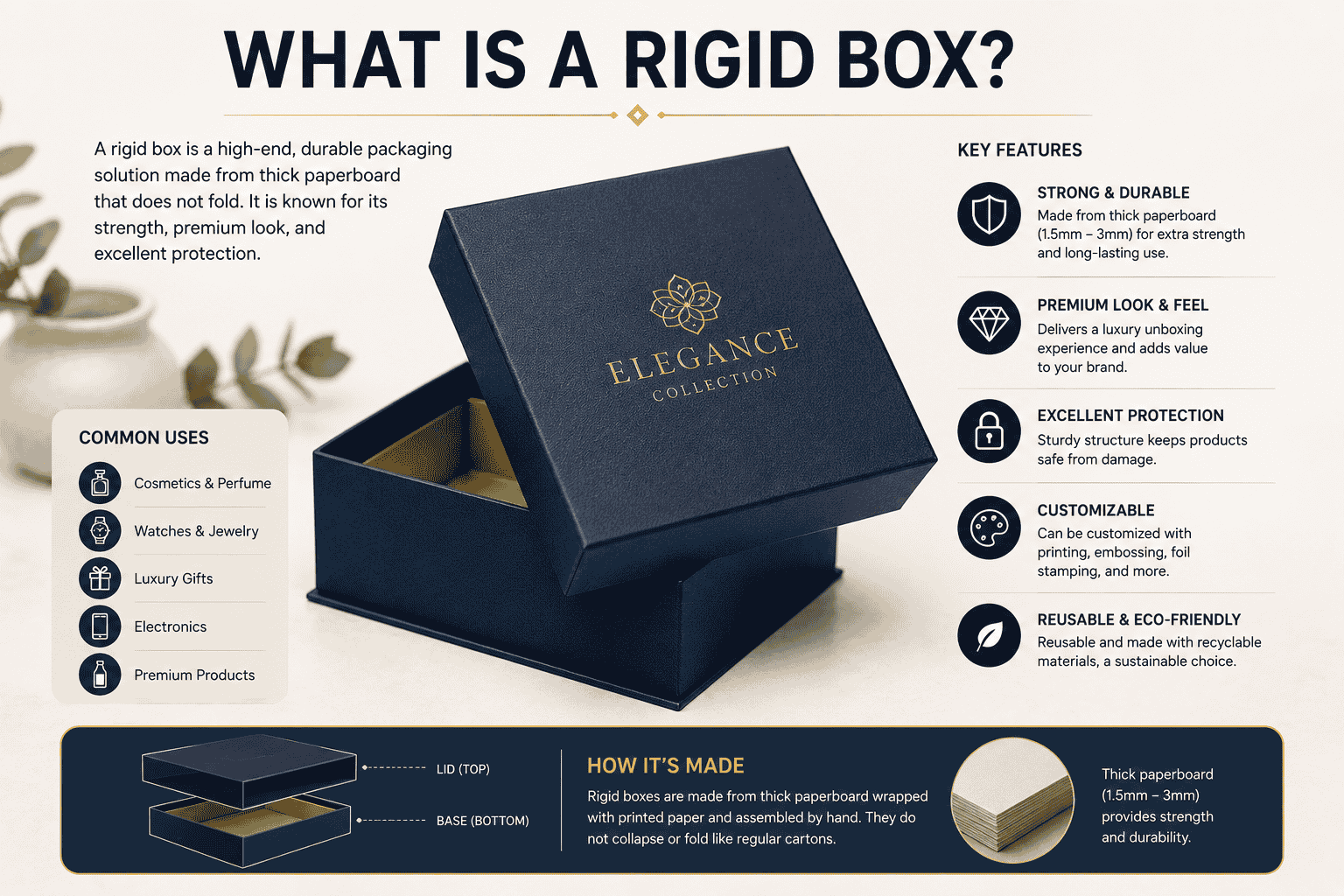
A rigid box (sometimes called a “set-up box”) is made from thick, dense paperboard — usually chipboard — that’s wrapped in a decorative outer layer like matte paper, textured stock, fabric, or foil-stamped material. Unlike a folding carton, a rigid box arrives pre-assembled. It doesn’t fold flat, it doesn’t pop into shape, and it can’t be shipped as a flat sheet. It’s built as a box and it stays a box.
Think of the packaging on a smartphone, a premium watch, or a bottle of high-end whiskey. That reassuring weight when you lift the lid, the soft-close feel, the way it looks like it belongs on a shelf rather than in a warehouse — that’s rigid packaging doing its job.
Common uses: electronics, cosmetics, jewelry, spirits and wine, corporate gift sets, subscription boxes with a premium positioning.
What Is a Folding Carton?
A folding carton is made from a thinner paperboard, die-cut and scored so it can be shipped flat and folded into shape at the point of packing. It’s the format behind most retail shelf packaging — cereal boxes, cosmetics cartons, pharmaceutical packs, food service boxes.
Folding cartons are printed directly on the board itself (rather than wrapped), which keeps production fast and costs low. Because they ship flat, you’re not paying to freight a box full of air — a real consideration once you’re ordering by the pallet.
Common uses: retail and grocery packaging, e-commerce shipping boxes, pharmaceuticals, food and beverage cartons, mailers, and subscription products where cost-per-unit matters more than tactile luxury.
Rigid Boxes vs. Folding Cartons: Side-by-Side Comparison
| Factor | Rigid Boxes | Folding Cartons |
| Material thickness | Thick chipboard (often 3–4x heavier) | Lighter paperboard |
| Assembly | Pre-assembled, ships as a finished box | Ships flat, folds together at packing |
| Shipping cost | Higher — you’re shipping volume, not flat stock | Lower — flat-pack saves freight space |
| Unit cost | Higher per unit | Lower per unit, especially at scale |
| Perceived value | Premium, luxury feel | Practical, clean, brand-consistent |
| Print method | Wrapped outer material (foil, fabric, textured paper) | Printed directly on the board |
| Durability | Very high — holds shape under pressure | Good, but can crush or dent more easily |
| Storage footprint | Larger — can’t be flattened | Small — stacks flat until needed |
| Best order volume | Small to mid-size runs, premium lines | Mid to high-volume runs |
| Typical lead time | Longer, more finishing steps | Shorter, more automated production |
Cost: Where the Real Decision Usually Gets Made
Most buyers don’t choose rigid vs. folding on aesthetics alone — it comes down to unit economics. A rigid box will almost always cost more per unit than a folding carton of similar size, for two reasons: the material itself is heavier and more expensive, and the wrapping process is more labor-intensive than direct printing.
Then there’s freight. Folding cartons ship flat, so a truck or container can carry thousands of them in the space rigid boxes would need for a few hundred. If you’re shipping internationally or across the country regularly, that difference compounds fast.
None of this means rigid is a bad investment — for a $180 skincare set, the box is part of what justifies the price. But for a $12 retail item, a rigid box can eat your margin before the product even ships.
Durability and Protection
Rigid boxes win on raw strength. The thicker board resists crushing, holds its shape in transit, and protects fragile or heavy contents — think glass bottles, ceramics, or electronics — better than a folding carton typically can on its own.
Folding cartons aren’t fragile, but they rely more on smart structural design (locking tabs, reinforced corners, insert trays) to protect what’s inside. For lightweight products, that’s rarely an issue. For anything breakable or heavy, it’s worth either upgrading to rigid or adding internal protective inserts to a folding carton.
Unboxing Experience and Brand Perception
This is where rigid boxes earn their reputation. The weight, the soft magnetic or ribbon closures, the way the lid lifts off slowly instead of tearing open — these are deliberate design choices that shape how a customer feels about a purchase before they’ve even touched the product. If your brand story is built on premium positioning, that first physical impression matters as much as the product photography that got the click.
Folding cartons can still look excellent — smart die-cut windows, spot UV, soft-touch coatings, and clean typography go a long way — but they read as “well-designed retail packaging” rather than “gift.” That’s not a flaw, it’s a different job. A cereal box isn’t supposed to feel like a jewelry box.
Sustainability Considerations
Both formats are typically recyclable paperboard, but folding cartons generally have a lower environmental footprint per unit: less material, lighter shipping weight, and often less mixed-material construction (no fabric or foil wrapping to separate out at recycling). If sustainability messaging is central to your brand, a folding carton with FSC-certified stock and soy-based inks is usually the easier sell to environmentally conscious customers — though rigid boxes made from recycled chipboard and printed with eco-inks can close that gap.
Which One Should You Choose?
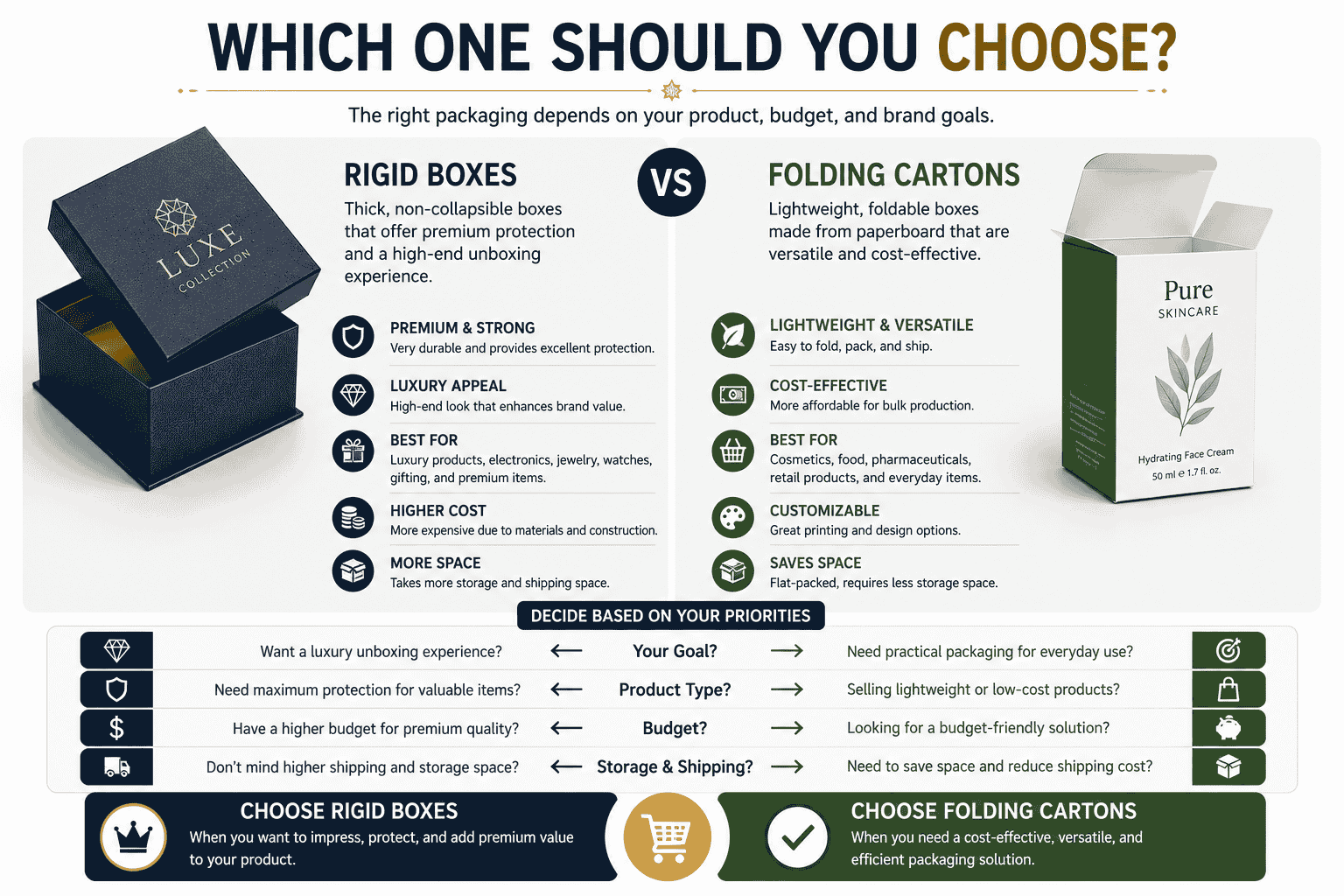
A few questions worth asking before you commit to either format:
- What’s the retail price point? Higher-priced items can absorb rigid packaging costs more comfortably than budget products.
- How is it sold? Rigid boxes shine for direct-to-consumer unboxing and gifting. Folding cartons are built for shelf presence and high-volume distribution.
- What’s the order volume? Small, curated runs suit rigid box economics. Large production runs favor folding cartons.
- What does the product need physically? Fragile, heavy, or high-value items lean rigid. Lightweight, standard retail items are well served by folding cartons.
- What’s the shipping distance and frequency? Frequent, long-distance shipping favors the lower freight cost of flat-packed folding cartons.
There’s also a middle path worth knowing about: rigid-style folding boxes, which mimic the sturdier look of a rigid box while still folding flat for shipping and storage. They’re a reasonable compromise when you want a premium feel without the full cost and storage burden of true rigid packaging.
Final Thoughts
Neither format is “better” in the abstract — they’re built for different jobs. Rigid boxes sell an experience; folding cartons sell efficiency at scale. The right call depends on your price point, your volume, and how much of your brand story is riding on the moment someone opens the box.
If you’re still weighing the two for your specific product, [our packaging team] can put together sample options in both formats so you can compare weight, finish, and cost side by side before committing to a production run.