
Order the wrong wall thickness once, and you won’t forget the lesson anytime soon. Either you’ve overpaid for protection your product never actually needed, or you’re now staring at a customer complaint about a crushed corner that a slightly sturdier box would’ve stopped cold. Both mistakes happen constantly, and both usually trace back to the same thing — not really understanding the difference between single wall and double wall before hitting order.
Sounds like a minor technical detail, sure. But it quietly shapes your cost, your shipping weight, and honestly how many complaint emails land in your inbox after launch. So let’s actually get into what separates these two, and how you figure out which one your product genuinely needs.
What “Wall” Even Means Here
Before comparing anything, it helps to know what people actually mean by “wall” in a cardboard box, since it’s not just referring to the sides.
The Layered Structure Nobody Really Thinks About
Corrugated cardboard isn’t one flat sheet — it’s layered, usually a fluted, wavy sheet of paper sandwiched between flat liners on either side. That wavy middle bit is where all the strength comes from, since the wave shape resists crushing way better than a flat sheet of the same material ever could on its own.
Single vs Double, in Plain Terms
A single wall box has one fluted layer between two flat liners — one flute, two liners, three layers total. Double wall basically stacks a second flute and liner right on top of that, so you end up with two flutes and three liners, five layers total. More layers, obviously, means more material, more rigidity, and — no surprise — more cost per box.
Single Wall: The Everyday Default
This is what most people picture the second you say “cardboard box,” and honestly, that’s fair, since it covers the vast majority of everyday shipping needs without much fuss.
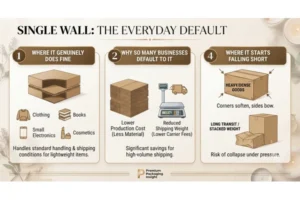
Where It Genuinely Does Fine
Clothing, books, small electronics, cosmetics, most subscription box contents — single wall handles all of this without breaking a sweat. Sturdy enough for normal handling, standard shipping conditions, no real risk of the box folding in on itself or the product sliding around too much inside.
Why So Many Businesses Default to It
Cost, mostly. Less material, less weight, and since a lot of carriers charge partly based on weight, that adds up to real savings both on production and shipping. If you’re moving thousands of units a month, that per-box difference stops being small pretty quickly.
Where It Starts Falling Short
Heavier stuff, fragile stuff, or anything traveling a long way through multiple hands starts pushing single wall past what it’s really built for. Load something dense enough into a single wall box, and eventually it shows — corners soften, sides start bowing a little, or worse, it just collapses under stacked weight sitting in a warehouse somewhere.
Double Wall: For When the Stakes Are Higher
Double wall exists purely for situations where single wall’s limits become a real risk rather than something theoretical you’re just worrying about.
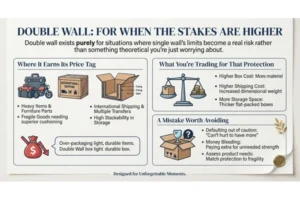
Where It Actually Earns Its Price Tag
Heavy items, fragile stuff needing real cushioning, anything shipping internationally through several transfers between trucks, planes, and warehouses — all of that benefits from the extra rigidity. Furniture parts, appliances, glassware, anything stacked heavily in storage tends to need this level of protection, since the second fluted layer resists crushing and punctures way better than single wall ever will.
What You’re Trading for That Protection
More material means more weight, more weight means higher shipping cost per unit, on top of the box itself already costing more to make. It also eats up more storage space flat-packed, since the boxes are noticeably thicker even before anyone assembles them. None of this makes double wall a bad call — it just means the extra protection actually has to be earned by what’s inside, not assumed by default.
A Mistake Worth Avoiding
Plenty of businesses just default to double wall out of caution, figuring “more protection can’t hurt.” Except it kind of does, once cost enters the picture. Paying extra for structural strength a light, sturdy product never needed is just money bleeding out across every single unit you ship.
So How Do You Actually Decide?
This isn’t really about preference. It comes down to a few practical questions about your specific product.
Start With Weight
How much does your product actually weigh, fully packed, inserts and all? Lighter stuff, generally under a few kilograms, usually does fine in single wall. Heavier items start nudging you toward double wall territory, especially anything that could shift and strain the box’s corners mid-transit.
Fragility Doesn’t Always Match Weight
A light but fragile item — glass ornaments, ceramics, some electronics — might still need double wall’s extra cushioning even though weight alone wouldn’t suggest it. Weight and fragility don’t always point the same direction, so it’s worth thinking about them separately instead of assuming one automatically covers the other.
Distance and Handling Change Things Too
Something shipping locally, handled once or twice between warehouse and doorstep, faces way less stress than something crossing borders through multiple transfer points, each one another chance for rough handling or stacking pressure. Longer, messier shipping routes tend to justify double wall, even for stuff that would’ve been perfectly fine in single wall on a shorter trip.
Don’t Forget Storage and Stacking
If your product sits stacked several boxes high in a warehouse for weeks before it even ships, that constant pressure adds up in a way a quick two-day delivery never will. Long-term storage under stacked weight usually calls for the extra rigidity double wall gives you, no matter how sturdy the product inside actually is.
Test Before You Commit to the Full Order
Whatever seems right on paper, actually test a sample before locking in a bulk order. Pack the real product, seal it up, and run it through a rough version of what it’ll actually face — drop it a few times from a reasonable height, stack some weight on top, leave it a day, check for bowing or weak spots. Way cheaper to find a problem in ten test boxes than in five thousand units already sitting in your warehouse.
Bottom Line
Single wall and double wall aren’t really competing against each other — they’re built for different jobs entirely. Single wall covers most everyday shipping efficiently and cheaply. Double wall steps in exactly where that everyday level of protection genuinely isn’t enough anymore. Figure out where your product actually sits between those two, based on weight, fragility, and how far it’s really traveling, and honestly, the right choice usually becomes obvious pretty fast.