
What Is the Standard Business Card Size?
Have you ever ordered some business cards and then looked at the size field and thought, “What should I write?” One of the most often asked questions in print and design and the answer is quite simple.
In the USA, the normal business card size is 3.5 x 2 inches (88.9 x 50.8 mm). This size has been the standard in the industry for decades and it is a size that fits in wallets, standard cardholders, and badge sleeves, without folding or cutting. Compact, professional and industry standard in North America.
The primary problem with most guides, though, is that there is no such thing as “standard. When creating cards for European, Japanese or Australian clients, sizes change. When you print things the wrong size for the wrong market, your cards won’t fit into wallets, holders or the minds of those you’re attempting to impress.
This guide provides you with all the dimensions you need in all the units and regions, and only once!
Standard Business Card Dimensions at a Glance
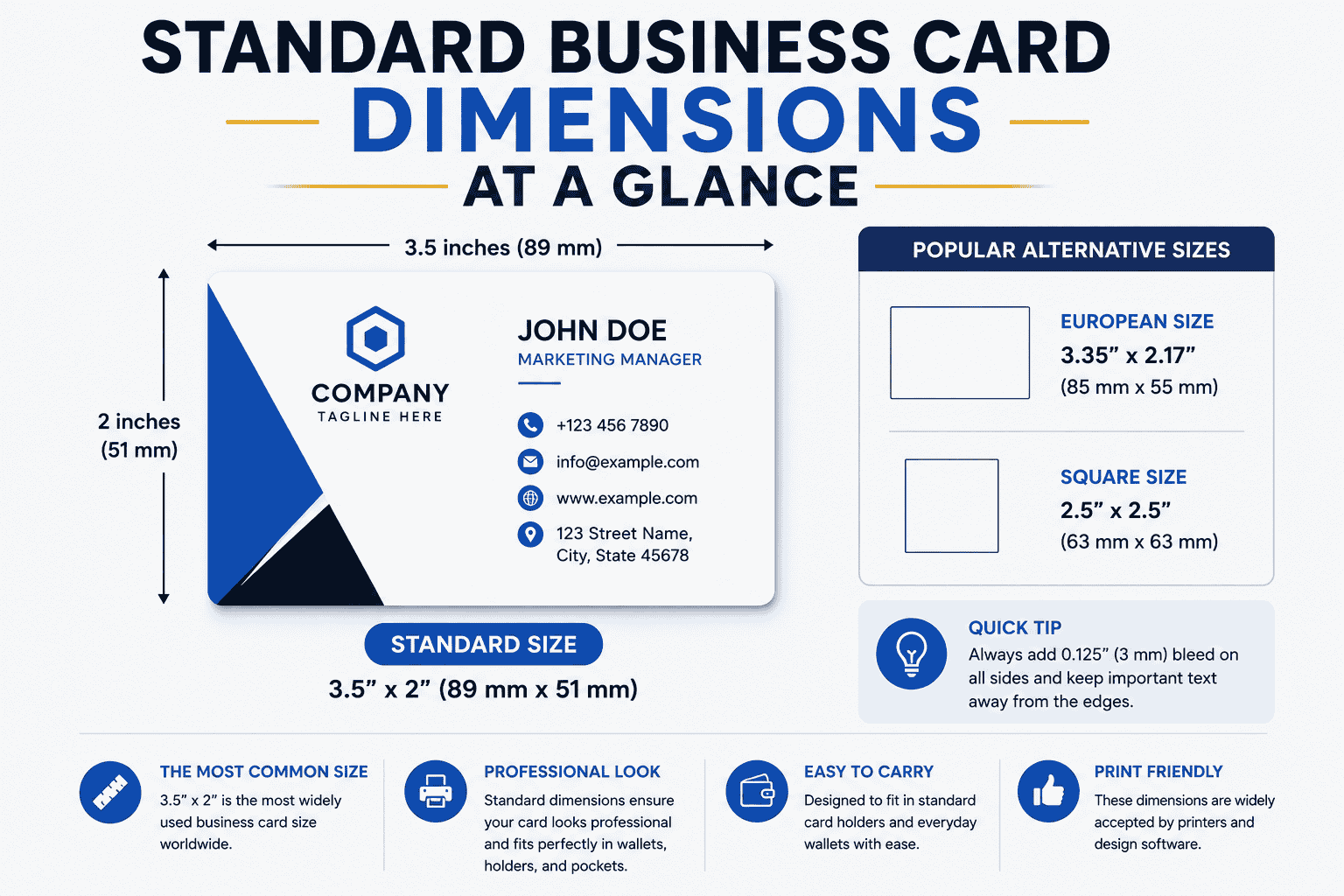
| Region | Size (Inches) | Size (mm) | Notes |
| USA & Canada | 3.5″ x 2″ | 88.9 x 50.8 mm | The most widely printed format |
| Europe (ISO) | 3.346″ x 2.165″ | 85 x 55 mm | Matches EU wallet & bank card slots |
| United Kingdom | 3.346″ x 2.165″ | 85 x 55 mm | Follows ISO standard |
| Japan (Meishi) | 3.582″ x 2.165″ | 91 x 55 mm | Extra width for Japanese characters |
| China & SE Asia | 3.543″ x 2.125″ | 90 x 54 mm | Common across Hong Kong, Malaysia, Singapore |
| Australia & NZ | 3.543″ x 2.165″ | 90 x 55 mm | Also used in Scandinavia |
| South America / Eastern Europe | 3.543″ x 1.968″ | 90 x 50 mm | Common across Argentina, Brazil, Eastern EU |
What Is Business Card Bleed Size?
Here’s a concept that trips up first-time buyers: bleed.
When a printing press cuts sheets down to card size, the blade can shift slightly — even by a millimeter or two. If your design sits right at the edge, that shift creates a thin white border where color or imagery was supposed to be. Bleed is the buffer zone that prevents this.
For standard US business cards:
- Full design with bleed: 3.75″ x 2.25″ (3.81 mm added to each side)
- Safe zone (keep text here): 3.25″ x 1.75″ (inset 0.125″ from each edge)
- Final trim size: 3.5″ x 2″
Think of it in three layers:
- Bleed area — extends beyond the card; gets cut off
- Trim line — the actual cut line, your card’s final size
- Safe zone — where all important content (name, phone, logo) must live
How to Set Up Your Business Card File for Print
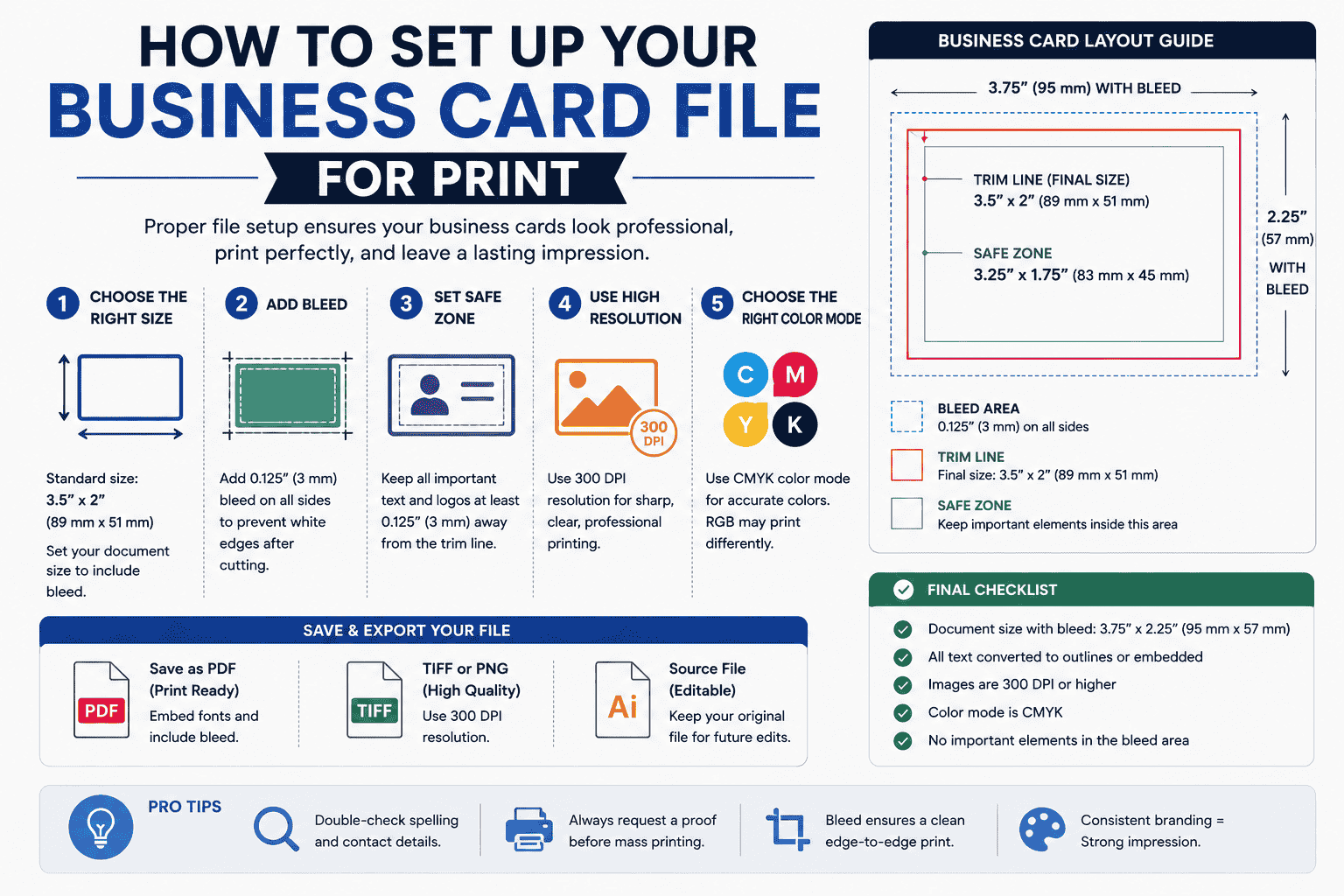
Getting the dimensions right is step one. Here’s how to make sure your file is actually print-ready:
Step 1: Set your document size to 3.75″ x 2.25″ (full bleed for US cards). This is larger than your final card — it includes the bleed area.
Step 2: Mark your trim line at 3.5″ x 2″. This is the actual edge of your finished card.
Step 3: Keep all text and logos inside the 3.25″ x 1.75″ safe zone, inset 0.125″ from the trim line on all sides. Anything outside this zone risks being clipped.
Step 4: Set resolution to 300 DPI minimum. Higher is fine; lower will look soft in print.
Step 5: Use CMYK color mode, not RGB. RGB is for screens; CMYK is for ink. Colors shift when converted at the printer’s end — designing in CMYK from the start ensures your colors print as intended.
Step 6: Embed all fonts or outline them. If a printer doesn’t have your font installed, they’ll substitute a default, which will ruin your layout.
Step 7: Export as a press-quality PDF. This is the standard file type for professional print. Most printers accept PDFs with bleeds and crop marks included.
Final Takeaway
The standard business card size in the US is 3.5 x 2 inches, which has become a status quo in every business card wallet, cardholder, and desk drawer in North America. However, the right size is one that fits your market, your brand, and also does not allow any compromise with your design.
Measure for size. Ensure the correct bleed. Select a cardstock that matches the quality of your product. If you need any assistance translating any of this to a finished card, that’s what we’re here for!