
Every printed page, envelope, poster, or box liner you’ve ever touched was cut to a “standard” size for a reason: it makes printing, mailing, filing, and packaging predictable and efficient. But most people only know one or two sizes by name — A4 or Letter — without understanding where they come from, how they relate to each other, or which one actually fits their project.
This guide breaks down every major paper size standard in plain language, with accurate measurements you can use right now.
Why Standard Paper Sizes Exist
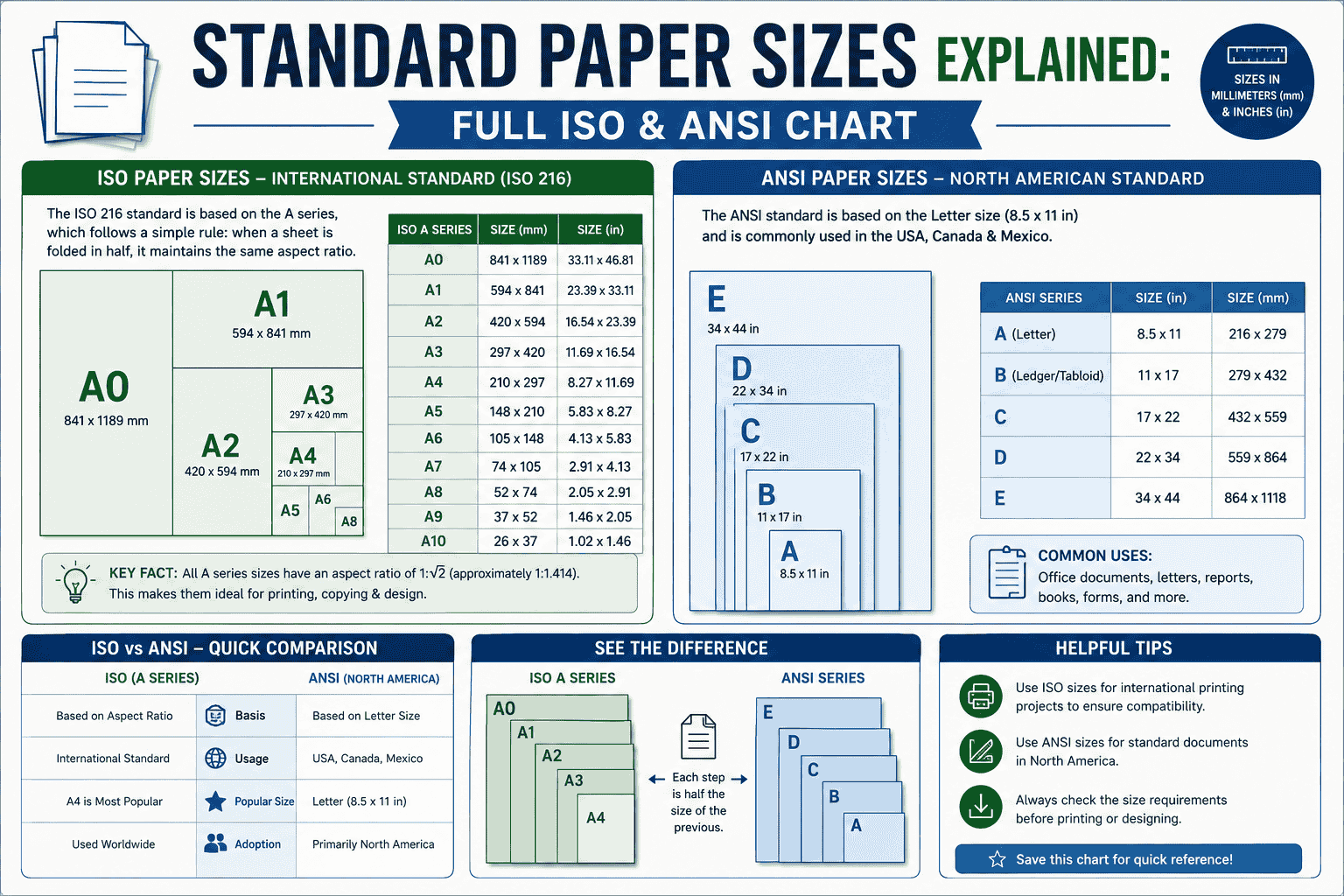
Before international standards, printers and paper mills each used their own dimensions, which made trimming, binding, and equipment design inconsistent and wasteful. Standardized sizing solves three practical problems:
- Compatibility – printers, scanners, envelopes, folders, and binders are all built around the same handful of dimensions.
- Efficiency – standard sizes minimize offcut waste when paper is cut from large master sheets.
- Predictability – a document made in one country prints and files correctly almost anywhere else, provided the same standard is used.
Today there are two dominant systems: the ISO 216 metric standard (used across most of the world) and the ANSI/US customary system (used mainly in the United States, Canada, and parts of Latin America).
ISO 216: The A-Series (Used Worldwide)
ISO 216 is the international standard behind the “A” sizes. It’s built on one elegant rule: each size is exactly half the area of the one before it, cut across the longer dimension, and every size keeps the same aspect ratio — 1:√2 (roughly 1:1.414). That’s why an A4 sheet folded in half becomes an A5 sheet with identical proportions.
A0 is the anchor of the system: its area is exactly 1 square meter.
A-Series Paper Size Chart
| Size | Millimeters (mm) | Inches | Common Use |
| A0 | 841 × 1189 | 33.1 × 46.8 | Technical drawings, architectural plans, large posters |
| A1 | 594 × 841 | 23.4 × 33.1 | Flip charts, large posters, display panels |
| A2 | 420 × 594 | 16.5 × 23.4 | Wall charts, small posters |
| A3 | 297 × 420 | 11.7 × 16.5 | Spreadsheets, drawings, tabloid-style layouts |
| A4 | 210 × 297 | 8.3 × 11.7 | Letters, forms, brochures, everyday office printing |
| A5 | 148 × 210 | 5.8 × 8.3 | Notepads, booklets, flyers |
| A6 | 105 × 148 | 4.1 × 5.8 | Postcards, invitations, small flyers |
| A7 | 74 × 105 | 2.9 × 4.1 | Tags, small notepads |
| A8 | 52 × 74 | 2.0 × 2.9 | Gift tags, miniature labels |
A4 is the de facto global standard for business documents — used in over 150 countries for everything from letterheads to legal contracts. The United States is one of the few major economies that doesn’t use it as the default.
ISO 216 B-Series and C-Series
The A-series doesn’t cover every need, which is why ISO 216 (and the related ISO 269) also defines two supporting series:
- B-Series — sits between two consecutive A sizes and is mainly used for posters, passports, and books where A-series proportions don’t quite fit.
- C-Series — used almost exclusively for envelopes, sized so that an A-series sheet fits inside without folding. A C4 envelope, for example, is designed to hold an unfolded A4 sheet; a C6 envelope holds an A4 sheet folded into quarters.
| Envelope Size | Millimeters | Fits |
| C4 | 229 × 324 mm | A4 flat (unfolded) |
| C5 | 162 × 229 mm | A4 folded in half |
| C6 | 114 × 162 mm | A4 folded in quarters |
ANSI Paper Sizes (United States Standard)
In the US, Canada, and the Philippines, paper is sized under the American National Standards Institute (ANSI) system, measured in inches rather than millimeters. Unlike the A-series, ANSI sizes don’t share one universal aspect ratio, which is why scaling a Letter document up to Tabloid isn’t a perfectly clean fit the way A4 to A3 is.
| ANSI Size | Name | Inches | Millimeters | Common Use |
| ANSI A | Letter | 8.5 × 11 | 216 × 279 | Everyday US business documents |
| — | Legal | 8.5 × 14 | 216 × 356 | Contracts, legal documents |
| — | Tabloid / Ledger | 11 × 17 | 279 × 432 | Newspapers, spreadsheets, ledgers |
| ANSI B | — | 11 × 17 | 279 × 432 | Engineering drawings |
| ANSI C | — | 17 × 22 | 432 × 559 | Technical/architectural drawings |
| ANSI D | — | 22 × 34 | 559 × 864 | Large-format drawings |
| ANSI E | — | 34 × 44 | 864 × 1118 | Full-size engineering plots |
Letter (8.5″ × 11″) is the closest US equivalent to A4, though it’s slightly shorter and wider — a detail that regularly trips people up when documents are shared internationally, since A4 files can print with unexpected margins on Letter-format printers, and vice versa.
A4 vs. Letter: What’s the Real Difference?
| A4 | Letter | |
| Dimensions | 210 × 297 mm | 216 × 279 mm |
| In inches | 8.27 × 11.69 in | 8.5 × 11 in |
| Aspect ratio | 1:1.414 (√2) | 1:1.294 |
| Used in | Most of the world | US, Canada, parts of Latin America |
A4 is narrower and longer; Letter is wider and shorter. The difference is small — about half a centimeter in each direction — but it’s enough that documents formatted for one will need adjusting before printing cleanly on the other.
How to Choose the Right Paper Size
A few practical rules of thumb:
- Match the standard to your audience’s region. Use A-series for international, EU, UK, or Asia-Pacific audiences; use ANSI/Letter for US-based printing and mailing.
- Think about the end use, not just the format. Marketing flyers often work well at A5 or Letter-half sizes; technical drawings need A3/A2 or ANSI C/D for legibility; postcards and inserts fit naturally at A6.
- Factor in packaging and mailing. If a document needs to go into a standard envelope, box, or mailer, choose the paper size the envelope was designed for (see the C-series table above) rather than resizing after the fact — it avoids awkward folds and wasted space.
- Account for bleed and trim. For anything professionally printed, oversized formats like SRA and RA exist specifically to allow ink to bleed off the edge before trimming to the final A-series size.