
I still remember the first time someone explained offset printing to me on a factory floor, and honestly, half of it went over my head at first. But once you see the plates, the rollers, and the paper moving through, it clicks. It’s not magic. It’s just a really smart use of the fact that oil and water don’t mix.
Almost every glossy magazine, business card, or well-made brochure you’ve ever picked up probably went through this process. Digital printing has grown a lot in the last few years, sure, but offset hasn’t gone anywhere. Once you’re printing in bulk, nothing else really competes with it on quality and price.
So let’s actually get into how it works.
What Offset Printing Really Means
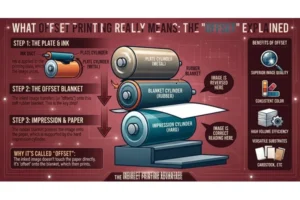
Here’s the short version: the ink doesn’t go from the plate straight onto paper. It lands on a rubber blanket first, and that blanket is what actually presses onto the paper. That middle step is where the name comes from, the image gets “offset” before it ever touches what you’re printing on.
Seems like an unnecessary detour, doesn’t it? But that extra step is exactly why the print comes out so clean. Newspapers rely on it. Book publishers rely on it. Packaging companies rely on it. There’s a reason this method hasn’t been replaced yet.
Why Businesses Keep Coming Back to It
Money, mostly. Setting up an offset job costs more upfront than digital, plates have to be made, the press needs calibration, there’s a whole prep phase. But once that’s done, each additional copy gets cheaper. Print 500 and it’s expensive per piece. Print 50,000 and suddenly the math looks completely different. That’s the whole appeal for anyone doing bulk orders.
Walking Through the Actual Process
I’ll go step by step here because skipping any one of these actually shows up in the final print, sometimes in ways you’d notice right away, sometimes not until later.
Prepress Comes First
Nothing gets printed until the design is locked down and separated into colors. This is called color separation, and it splits the artwork into four layers: Cyan, Magenta, Yellow, and Black, or CMYK if you’ve heard that term before. Each of those colors gets its own plate.
If something’s off here, it’s expensive to fix later, so this step gets checked more than once, usually by more than one person.
Then the Plates Get Made
The separated colors are etched onto metal plates, aluminum usually. These plates are treated in a way where the image areas grab onto ink, and the blank areas push it away and hold water instead. That’s really the entire trick behind the whole process. Water and ink refusing to mix, used on purpose.
The Press Gets Set Up
Each plate goes onto a cylinder inside the press. There are three cylinders doing the actual work, the plate cylinder, the blanket cylinder, and the impression cylinder, and they all move together to carry the image from plate to paper.
Water Goes On First, Then Ink
This is the part people find most interesting once they understand it. A thin layer of water rolls over the plate first. Since water and ink don’t mix, it only sits on the blank areas, not the image itself.
Then ink comes in right after. It can’t stick where the water already is, so it only clings to the image areas, and that’s what keeps the print sharp instead of smudged.
The Blanket Does Its Job
Rather than pressing the plate straight onto paper, the ink moves onto a rubber blanket first. That rubber flexes a bit and adjusts to whatever surface it’s printing on, which is genuinely useful when the paper isn’t perfectly smooth.
Finally, Paper
From the blanket, ink transfers onto paper as it runs through under pressure from the impression cylinder. And this all happens fast, big commercial presses can churn out several thousand sheets an hour without slowing down.
Same Process, Different Color, Over and Over
Most printed stuff isn’t one flat color, so this whole cycle runs again for every plate. Cyan goes down, then Magenta on top, then Yellow, then Black. Stack them together and you get the full-color image sitting on the page.
Drying, Then Finishing
Once it’s printed, the sheets need to dry, air-dried sometimes, heat-assisted other times, depends on the setup. After drying comes the finishing work: cutting things down to size, folding, binding, sometimes laminating or adding a coating. This is really where flat sheets stop being sheets and start being an actual brochure or book or box you can hold.
Why Offset Still Holds Up
Quality that doesn’t fade under scrutiny. Text stays crisp, colors stay true, fine detail doesn’t blur. That’s still the main reason serious print jobs lean on offset instead of digital.
It rewards bulk orders. Setup costs more, but that cost spreads thin across a large run, so the price per piece drops fast once you’re ordering in volume.
It’s not fussy about materials. Cardboard, canvas, rougher textured stock, offset handles most of it without much trouble, which explains why packaging companies use it constantly.
Color stays consistent the whole way through. Since the same plates run the entire job, the first sheet and the ten-thousandth sheet should look nearly identical. For any brand that cares about how their material looks, that kind of reliability actually matters.
Offset or Digital? Depends What You’re Doing
People ask this constantly, and honestly it usually comes down to how much you’re printing.
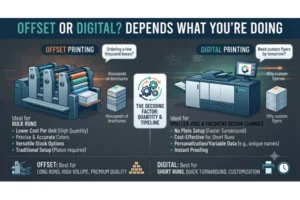
Go with offset for bulk runs, the cost per unit drops and colors come out more accurate. Go with digital for smaller jobs or anything where the design keeps changing, since there’s no plate setup and turnaround is much faster.
Ordering a few thousand boxes or brochures? Offset’s the right call. Need fifty custom flyers by tomorrow morning? Digital wins, easily.
Where This Shows Up Most Often
Books, magazines, newspapers, brochures and flyers, packaging and product labels, business stationery, posters, calendars. Basically anywhere a business needs both quality and volume in the same breath.
Wrapping Up
At its core, offset printing is about precision, separating colors correctly, moving ink through plates and blankets, laying it onto paper without much room for error. That precision is exactly why this method has survived so long, and why it’s still the first choice for big, quality-heavy print runs.
So next time you’re flipping through a glossy magazine or opening a nicely printed box, there’s a decent chance an offset press had something to do with how clean it looks.