
Open most kitchen drawers and you’ll find a roll of thin, semi-translucent paper — and chances are, nobody can say for certain whether it’s wax paper or butter paper. The two get mixed up constantly, sold under overlapping names, and used interchangeably online. That mix-up gets expensive fast: put the wrong one in a 400°F oven and you’ll end up with smoke, a melted mess, or a ruined batch of cookies.
This guide breaks down exactly what separates wax paper from butter paper — how each is made, where each one belongs, and how to pick the right one for your kitchen, bakery, or packaging line.
Quick Answer
| Wax Paper | Butter Paper (Parchment Paper) | |
| Coating | Paraffin or soy wax | Silicone (or acid-treated pulp) |
| Oven-safe | No — melts and can smoke | Yes — heat-resistant up to ~450°F |
| Best for | Wrapping, lining counters, cold storage | Baking, roasting, lining hot trays |
| Moisture resistance | High | High |
| Non-stick surface | Yes, but not heat-stable | Yes, and heat-stable |
| Reusable | Usually single-use | Often reusable 2–3 times |
If you remember one rule, remember this: wax paper is for cold and room-temperature tasks; butter paper is for the oven.
What Is Wax Paper?
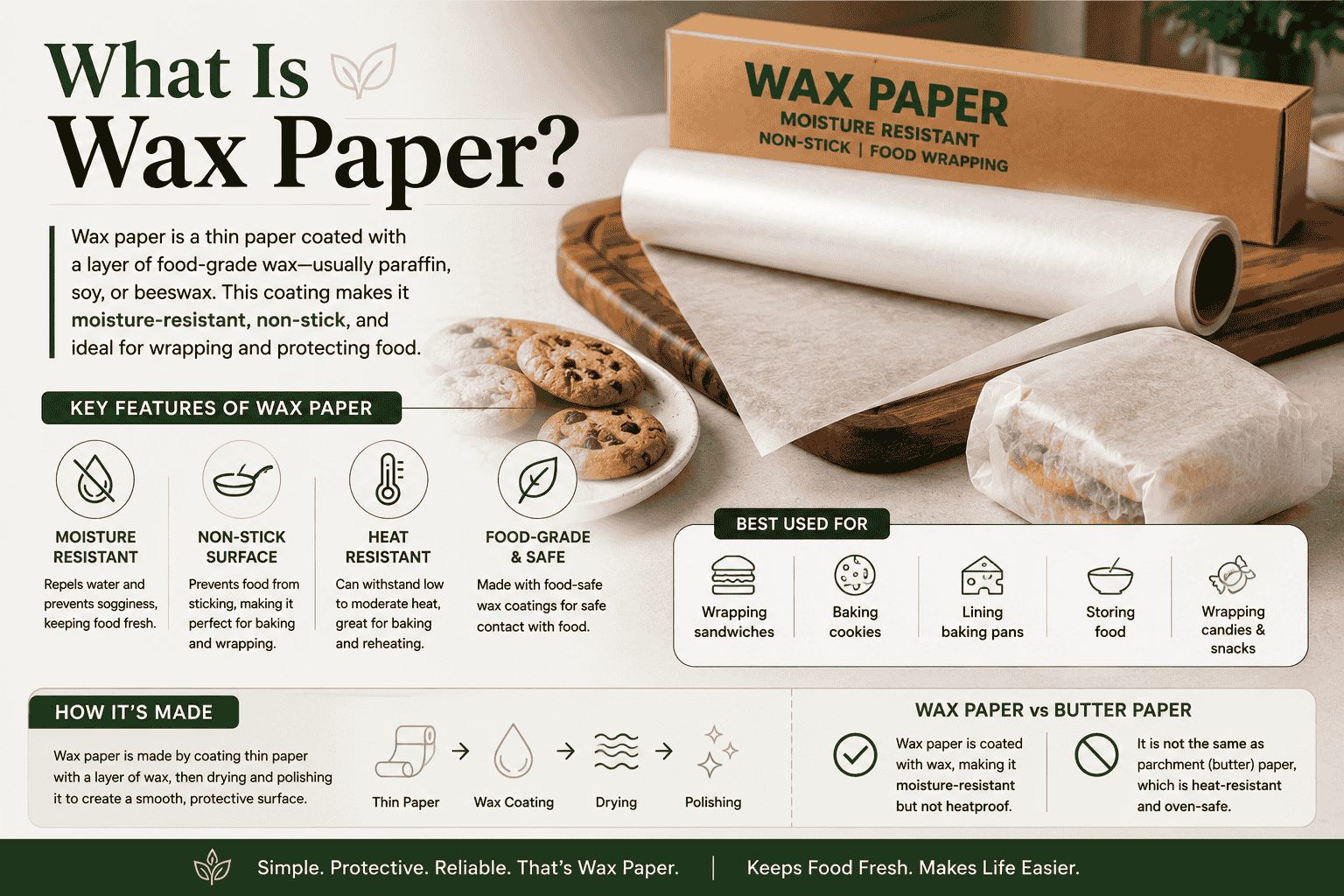
Wax paper is a sheet of paper coated on both sides with a thin layer of paraffin wax (sometimes soy-based wax for a more eco-friendly option). That coating is what gives it a slightly shiny, smooth feel and makes it resistant to moisture and grease.
Because the coating is wax, it does exactly what wax does when it meets heat — it softens, melts, and can even scorch or smoke. That’s why wax paper should never go inside an oven or under a broiler.
Common uses for wax paper:
- Wrapping sandwiches or snacks
- Lining countertops when rolling out dough or dusting with flour
- Separating layers of cookies, burger patties, or cold cuts for freezing
- Covering bowls during proofing or marinating
- Non-food uses like arts and crafts, drawer liners, or polishing wood
What Is Butter Paper?
Butter paper (often called baking paper, and in many regions used interchangeably with parchment paper) is treated to withstand heat. Depending on the manufacturing process, it’s either coated with a food-safe silicone layer or run through an acid bath that gives the paper pulp a dense, heat-resistant, non-stick surface.
Unlike wax paper, butter paper stays stable at high oven temperatures, which makes it the standard choice for anything that goes near direct heat.
Common uses for butter paper:
- Lining baking sheets for cookies, pastries, and cakes
- Roasting vegetables or meat without sticking
- Wrapping food for steaming (en papillote)
- Portioning and separating baked goods for storage
- Lining cake tins for easy release
Wax Paper vs Butter Paper: Key Differences
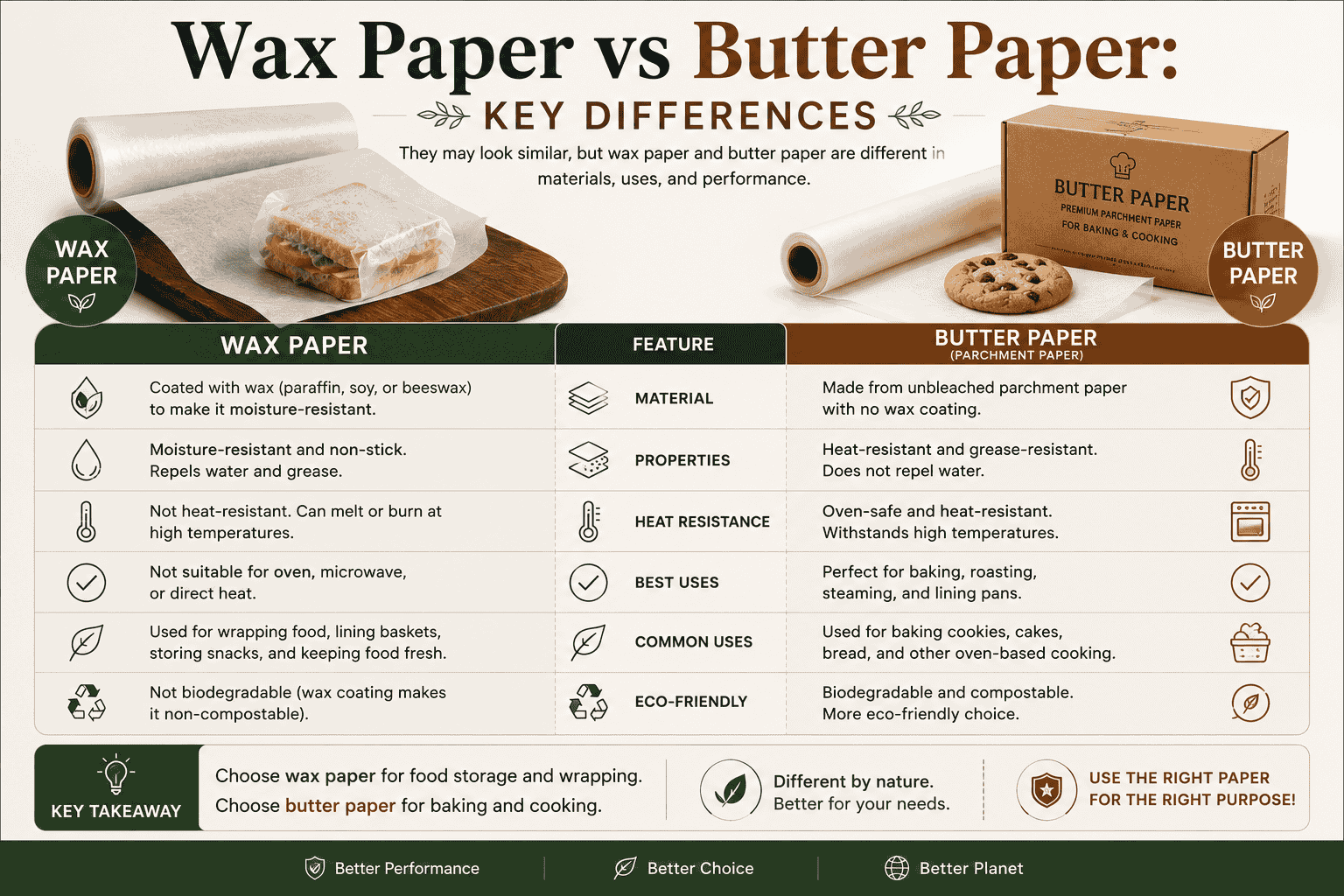
1. Heat Resistance
This is the difference that matters most. Butter paper can handle standard baking and roasting temperatures. Wax paper cannot — the wax coating breaks down well below typical oven temperatures.
2. Coating and Composition
Wax paper relies on a wax layer for its non-stick, moisture-resistant properties. Butter paper relies on silicone (or a parchmentizing process) instead, which is what allows it to stay food-safe and stable under heat.
3. Ideal Environment
Wax paper performs best in cold or room-temperature settings — refrigeration, freezing, or countertop prep. Butter paper is built for heat, but works fine at room temperature too, so it’s the more versatile of the two if you only want to stock one.
4. Reusability
Butter paper can often be reused for a batch or two of baking before it needs replacing. Wax paper is generally treated as single-use, since folding and unfolding can crack the wax coating.
5. Cost and Availability
Wax paper is typically the cheaper option and widely available in grocery stores. Butter paper/parchment paper costs a little more due to the specialized coating process, but the price difference is usually small for the added versatility.
Can You Substitute One for the Other?
Wax paper as a substitute for butter paper: No — not for anything that goes in the oven. If a recipe calls for parchment or butter paper and you only have wax paper, use a greased tray instead, or a silicone baking mat.
Butter paper as a substitute for wax paper: Generally yes. Since butter paper handles heat and cold equally well, it can stand in for wax paper in most wrapping or storage situations, even though it’s slightly more expensive to use for that purpose.
Which One Should You Choose?
- Baking, roasting, or anything oven-bound → Butter paper, every time.
- Wrapping food, freezing, or countertop prep → Wax paper is perfectly fine and more budget-friendly.
- Running a bakery, café, or food packaging line → Stock both, since each serves a distinct stage of food prep and presentation, and using the wrong one at scale can affect both safety and product quality.