
My cousin started a small granola-cereal brand last year — sells it at two farmers markets and online. She called me one night pretty stressed because her box supplier asked what height she wanted, and she had no idea. She’d genuinely never looked at a cereal box and thought about its measurements. Fair enough — most people haven’t. You grab it off the shelf, pour milk on it, move on with your life.
If you ended up here searching “cereal box dimensions,” you’re probably in one of two camps: running a food brand and need real numbers for packaging, or you’re just curious about something you never noticed before. Either way, here’s what you need.
Why the size matters
The size of a cereal box isn’t arbitrary — someone didn’t just pick numbers in 1960 and everyone copied it forever. There’s real logic behind it.
Grocery shelves have fixed gaps between rows. Warehouses stack pallets a certain way. And cereal is light and fluffy, not something you can compress into a small box the way you would rice or flour. Those constraints together shape how a box ends up looking.
It’s not just “however much cereal fits.” People assume the box size is dictated by the amount of cereal inside — not really. A brand could make a taller, skinnier box or a shorter, wider one holding the exact same amount. The shape usually comes down more to shelf space and how it looks next to competitors than to volume.
The actual numbers
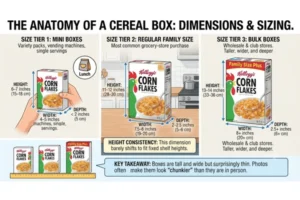
A typical grocery-store cereal box runs:
- Height: 11–12 inches
- Width: 7.5–8 inches
- Depth: 2–2.5 inches, sometimes a bit less
Picture a box of corn flakes on your counter — that’s basically it. About a foot tall, 8 inches wide, and thinner than most people picture in their head. Cereal boxes always look chunkier in photos than they are in person.
Height is the number that barely shifts across brands, and that tracks — shelves have a fixed gap, and nobody wants a box that scrapes the shelf above every time you reach for it.
Sizes vary by type
The mini box from a variety pack obviously isn’t the same as the bulk one from Costco. A few rough tiers:
Mini boxes — the kind in variety packs or vending machines. Around 6–7 inches tall, 4–5 wide, under 2 inches deep. Small enough for a lunch bag without a second thought.
Regular family size — what most people are actually buying. About 12 inches tall, close to 8 wide, depth in that 2–2.5 inch range.
Bulk boxes — taller (13–14 inches), a bit wider, and slightly deeper since there’s more cereal packed in.
Why so thin, though
This is the question people ask most, and it’s a fair one — a box 12 inches tall and only 2 inches deep looks strange once you actually stop and look at it.
Cereal doesn’t pack down tight like flour or sugar. It’s airy, full of gaps, and needs room or it crushes itself. But go too deep and the box eats up way more shelf space than a store wants to give one product. So brands land in between — thin enough to save shelf space, wide enough that the cereal isn’t getting crushed.
There’s also the plastic bag inside holding the cereal, which needs its own bit of room. That’s part of why depth rarely drops much below 2 inches even on the smaller boxes.
If you’re designing your own packaging
If you’re actually building a cereal-style product and need numbers to hand a manufacturer, the standard sizes above are a solid starting point, not a hard rule. Plenty of smaller cereal or granola brands tweak dimensions depending on branding or whatever shelf-space deal they’ve worked out with a retailer.
Keep depth around 2–2.5 inches if you want the box to play nice with standard supermarket shelving — go noticeably thicker and some stores may decline to stock it. Height has more give, but staying under 13 inches is a safe bet.
Bottom line
Cereal box sizes aren’t random — shelf space, shipping, and cereal’s need for breathing room all shape the final dimensions. Roughly 12 inches tall, 8 wide, just over 2 deep covers most of what you’ll see in a regular grocery aisle, with mini and bulk versions scaling down or up from there.