Walk into any grocery store and look at the bag holding your salad greens. Flip over a box of crackers. Open a tissue pack. Chances are, somewhere on that packaging, there are tiny holes you never thought twice about. Those holes aren’t random — they’re doing a job.
That’s perforated packaging. And once you understand what it does, you’ll start spotting it everywhere.
What Is Perforated Packaging?
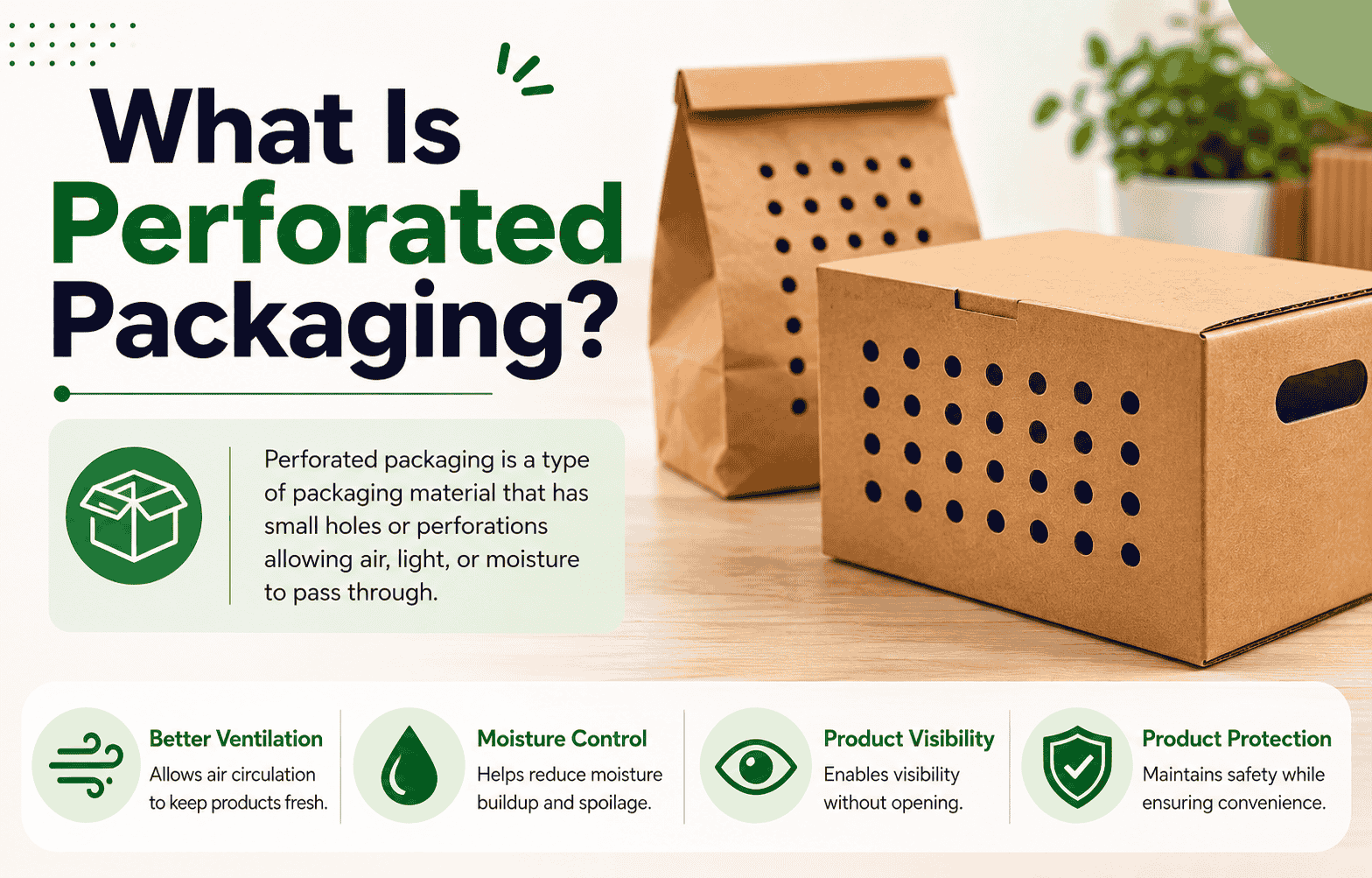
Perforated packaging is any packaging material — cardboard, plastic film, paper, or foil — that has been intentionally punched, slit, or cut with small holes to serve a specific function.
Those holes might be microscopic, barely visible to the eye. Or they might be larger, arranged in a tear line along the edge of a box. Either way, they’re placed deliberately. The goal is to control what gets in or out: air, moisture, gases — or to give the customer a clean, defined way to open the package without scissors.
The concept is straightforward. The execution, though, takes real precision. Hole size, spacing, placement, and pattern all affect how the package performs. Get it wrong and you either compromise the product inside or defeat the purpose of having the packaging at all.
How Perforations Are Made
There are two main techniques used in commercial production:
Mechanical perforation uses rotating pins, blades, or rollers to punch holes into material at high speed. It’s cost-effective, works well for large production runs, and handles cardboard, film, and paper efficiently. For standard tear-line packaging and bulk produce bags, this is the most common method.
Laser perforation uses focused laser beams to burn precise, uniform holes into material. It’s more accurate than mechanical punching, capable of producing holes as small as 40 to 60 microns in diameter. This level of control matters for applications like fresh produce or ready-to-eat meals, where the gas exchange rate has to be dialed in exactly. Laser perforation is the preferred method in food-grade and pharmaceutical applications for this reason.
Why Perforated Packaging Works: The Real Benefits
1. Extends Product Shelf Life
This is the biggest reason perforated packaging exists in food and produce. Fresh fruits and vegetables continue to respire after harvest — they take in oxygen and release carbon dioxide and ethylene gas. Without ventilation, that gas buildup accelerates spoilage. Perforations let gases escape while maintaining the right humidity level inside the package. Perforation increases the shelf life of fruits and vegetables by typically three to four days, which leads to a meaningful reduction in food waste.
2. Prevents Moisture Buildup
Trapped moisture is one of the fastest ways to ruin a packaged product — mold, sogginess, contamination. Perforations give moisture a way out. For baked goods, this means bread stays crusty instead of going limp. For produce, it means leaves stay crisp instead of turning slimy.
3. Makes Products Easier to Open
Tear-line perforations are one of the most underrated features in retail packaging. A clean, intuitive opening mechanism reduces frustration at the point of use. Customers don’t need scissors. They don’t tear the wrong part of the box. The product comes out intact. That matters more than it sounds — difficult-to-open packaging is a real complaint that drives negative reviews and brand switching.
4. Tamper Evidence
A package with intact perforations signals to the buyer that it hasn’t been opened. Once the perforations are broken, that’s visible. This makes perforated packaging a practical tamper-evident solution for everything from over-the-counter medicine to food products.
5. Portion Control and Dispensing
Perforations can be designed to allow controlled dispensing of a product — one tissue at a time, one strip at a time, one serving section at a time. The rest of the package stays sealed. This is particularly useful for wet wipes, tissues, adhesive strips, and single-serve food formats.
6. Sustainable and Material-Efficient
Perforations remove material rather than add it. A perforated box uses less raw material than a solid one of the same design. Manufacturers are increasingly focused on using eco-friendly and recyclable materials in line with sustainability goals, and perforated formats support this by reducing excess material while maintaining product protection. Paper and cardboard perforated packaging is also naturally recyclable and compostable.
Perforations can be shaped — not just punched in straight lines. Brands use custom perforation patterns to create reveal panels, decorative cutouts, or interactive tear-away sections that make the unboxing experience more engaging. For subscription boxes, cosmetics, and premium retail products, this kind of detail contributes to how the brand is perceived.
Industries That Use Perforated Packaging
Food and Beverage
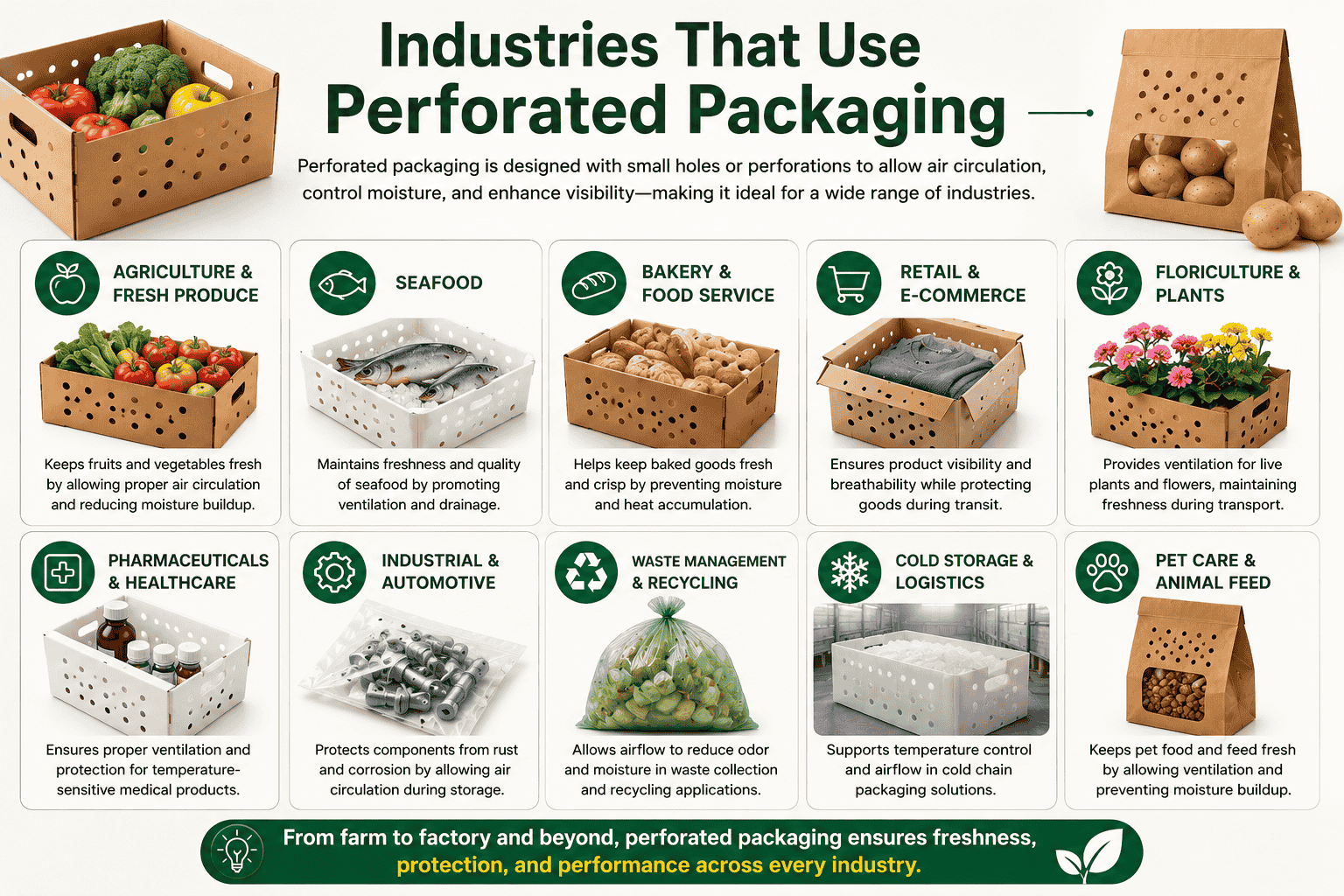
This is the dominant use case. Perforated packaging is widely adopted in the food and beverage industry due to its ability to preserve product freshness and control moisture. From produce bags to bakery trays to snack packaging, perforations show up across nearly every food category. The food sector is expected to capture 68% of the industry share in the perforated packaging market by 2025
Fruits and vegetables need to breathe. Perforated film bags and ventilated crates keep them respiring at the right rate without letting them dry out or rot from trapped humidity. Berries, salad greens, herbs, and pre-cut vegetables all rely on this.
Bakery
Bread, pastries, and baked goods need airflow to maintain texture. Perforated bags prevent condensation from building up inside, which would make crusts soft and accelerate mold growth.
Pharmaceuticals and Healthcare
Tear-line packaging for medicine strips and blister packs, ventilated trays for sterile equipment storage, and breathable wraps for medical devices all fall under this category. Precision matters here — both for product integrity and for regulatory compliance.
Retail and Display
Countertop display boxes with tear-away openings are a common retail packaging format. A single SKU can ship in a sealed box and convert into a display unit on the shelf without the retailer needing any tools. Perforations make this possible cleanly.
E-Commerce
E-commerce benefits from robust yet breathable packaging that ensures products like fresh produce arrive in optimal condition, satisfying consumer expectations for quality and freshness. As more grocery and food delivery happens online, perforated packaging plays a bigger role in keeping products viable through longer fulfillment chains.
Electronics
Electronics that generate heat during transport benefit from ventilated packaging. Perforated boxes allow heat to escape rather than build up inside the package, which reduces the risk of damage during shipping.
Perforated vs. Non-Perforated Packaging: A Comparison
| Feature | Perforated Packaging | Non-Perforated Packaging |
| Airflow | Controlled ventilation | Sealed / no airflow |
| Shelf life (perishables) | Extended | Standard |
| Ease of opening | Built-in tear lines | Requires tools or force |
| Moisture control | Releases excess moisture | Traps moisture |
| Material use | Reduced (holes remove material) | Full material usage |
| Best for | Fresh produce, bakery, display boxes, food retail | Non-perishables, liquid products, airtight storage |
What’s Driving Growth in Perforated Packaging
The perforated packaging market was valued at approximately USD 27.37 billion in 2024 and is projected to reach around USD 44.80 billion by 2034, growing at a CAGR of 5.05%. The growth is being pushed by a few converging factors.
Consumer demand for fresher food with fewer preservatives is increasing. Retailers and food brands are under pressure to reduce food waste. And sustainability requirements are making lightweight, recyclable, and material-efficient packaging more attractive across the board. Perforated packaging checks all three of these boxes.
Laser perforation technology is also becoming more accessible. As equipment costs drop, more manufacturers can afford the precision of laser-cut perforations rather than relying solely on mechanical methods. This opens up more customization options at a commercial scale.
Choosing the Right Perforated Packaging for Your Product
If you’re packaging fresh produce or baked goods, micro-perforated film with controlled hole sizing is the right direction. If you’re selling retail products that need an easy opening mechanism, tear-line perforation on a cardboard box covers that. If you’re building a display unit that needs to double as a shipping box, die-cut tear-away panels give you that flexibility.