Most businesses treat packaging as an afterthought — something you order once the product is ready, in whatever box is cheapest and available fastest. Then they wonder why their unboxing videos never get shared, why return rates are higher than competitors’, or why a product that costs more to make sells for less than a rival’s.
The box isn’t decoration. It’s the last thing you control before your product reaches the customer, and the first thing the customer actually touches. Get it wrong, and everything else you did right — the product quality, the marketing, the pricing — gets undermined at the finish line.
Here’s what custom packaging actually does for a business, backed by why it works, not just that it works.
1. It Changes What Customers Are Willing to Pay
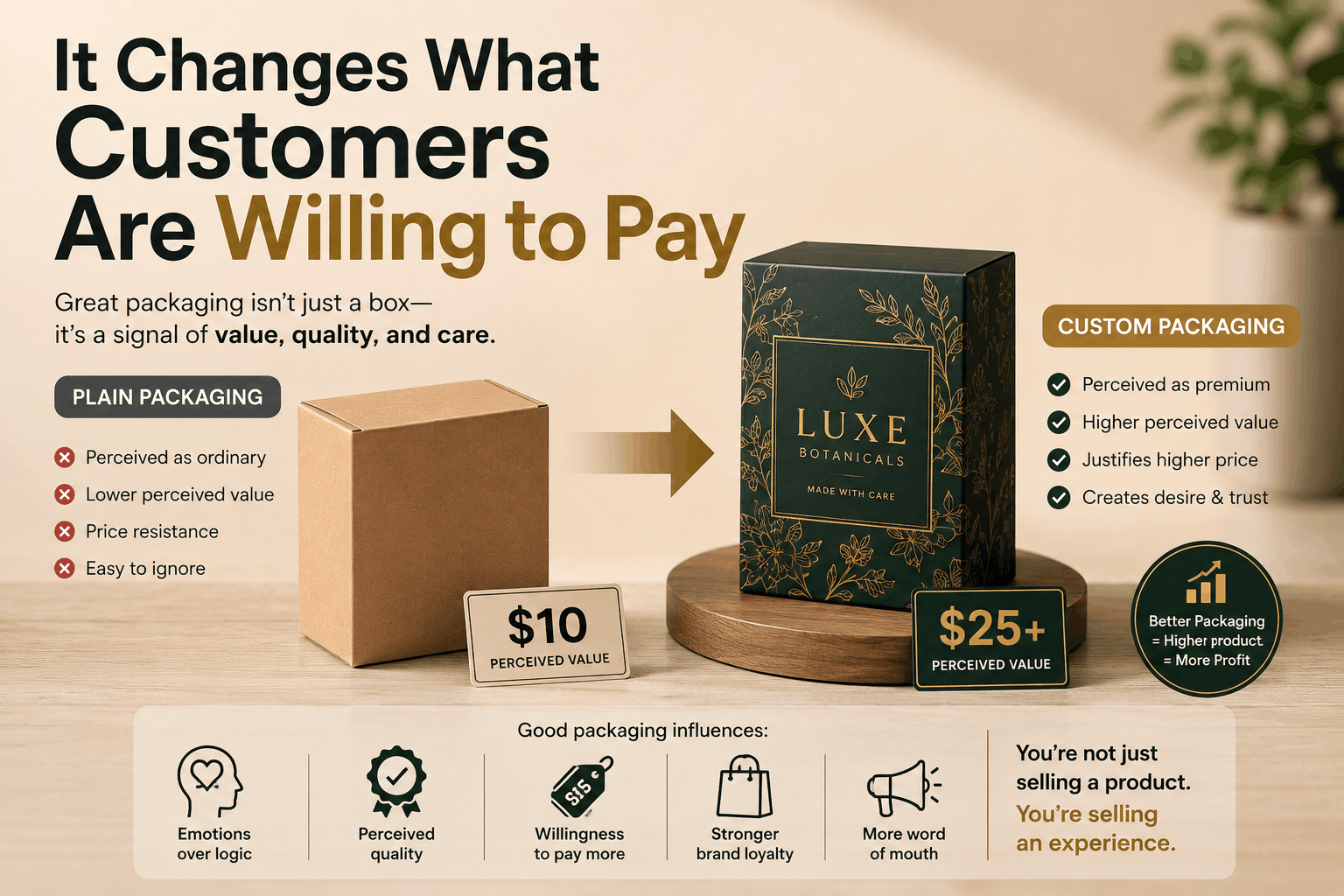
Identical products in different packaging don’t sell at the same price. This isn’t opinion — it’s a well-documented pricing effect: packaging shifts a product from “commodity” to “brand” in a buyer’s head within seconds, and buyers pay a premium for that shift.
Two businesses can sell the exact same soap bar. One uses a plain poly bag. The other uses a structured kraft box with a printed logo, a die-cut window, and matte finish. The second business isn’t just more attractive on a shelf — it can charge 20-40% more for the identical product, because the packaging has already told the customer “this is a considered, quality brand” before they’ve opened it.
What this means for you: if you’re competing on price alone, custom packaging is one of the few ways to exit that race without changing your product.
2. It Does Your Marketing After the Sale Is Already Made
Most marketing spend targets the moment before purchase — ads, SEO, influencer posts. Packaging is marketing that works after the sale, which is a completely different and often more valuable moment:
- Unboxing is peak attention. A customer who just bought your product is paying closer attention to it than at any other point in the relationship. A branded, well-designed box uses that attention window, while a generic brown box wastes it.
- It’s the #1 driver of unboxing content. Products with distinctive packaging get shared on social media without you paying for a single ad. This is free, credible marketing that generic packaging simply cannot generate.
- It reduces the need to re-convince customers. A logo, a QR code to your loyalty program, a thank-you card — all of this happens inside the box, cheaply, with zero ad spend.
3. It’s a Bigger Lever on Returns and Damage Costs Than Most Businesses Realize
This is the part competitors rarely mention because it’s less exciting than branding — but it often matters more to your bottom line.
Custom packaging isn’t just print and color. It’s engineered to the exact dimensions and fragility of your specific product:
| Factor | Generic/Stock Packaging | Custom-Fit Packaging |
| Product movement in transit | High (extra void space) | Minimal (snug fit) |
| Damage-related returns | Higher | Lower |
| Material used per unit | Often oversized, wasted | Sized to product, less waste |
| Perceived value on arrival | Neutral to negative | Positive |
A box that’s too large lets your product shift, collide with the walls, and arrive damaged. That’s a direct cost: refunds, replacements, and a customer who now associates your brand with “arrived broken.” Custom sizing is a logistics decision as much as a branding one.
4. It Signals Trust Before a Single Word Is Read
Buyers — especially first-time buyers — use packaging as a shortcut to answer a question they can’t otherwise verify: is this a real, legitimate business?
A generic box with no branding raises quiet doubts, particularly for newer or smaller brands trying to build credibility. A well-designed custom box answers that question before the customer even opens it:
- Consistent branding = “this business is established enough to invest in itself”
- Clear material and finish choices = “this business cares about details”
- Professional printing = “this isn’t a fly-by-night operation”
This matters most in categories where trust is the biggest barrier to a first purchase — cosmetics, supplements, CBD, subscription boxes, and anything shipped direct-to-consumer.
5. Material and Style Choice Changes the Message, Not Just the Look
Not every product should use the same packaging approach, and this is where a lot of businesses get it wrong — they pick what looks nice rather than what fits the product’s story.
- Kraft/recycled material signals sustainability and simplicity — strong fit for food, wellness, and eco-conscious brands.
- Rigid boxes signal premium and gifting — strong fit for electronics, jewelry, and luxury cosmetics.
- Corrugated boxes signal durability and function — strong fit for shipping and bulk retail products.
- Printed mailers/poly bags signal modern, direct-to-consumer efficiency — strong fit for apparel and lightweight goods.
Choosing the wrong category doesn’t just look off — it can actively work against the message you’re trying to send. A luxury skincare brand shipped in a flimsy poly bag undercuts its own pricing story.
6. Color Isn’t Decoration — It’s a Purchase Trigger
Color is one of the fastest-processed signals a customer receives, often registering before they’ve consciously read anything on the box. General associations that show up repeatedly in packaging and consumer behavior research:
- Black — premium, strength, sophistication
- Green — natural, organic, eco-friendly
- Red/Yellow — urgency, appetite, energy (common in food)
- Pastels — gentleness, care (common in baby and beauty products)
- White/minimal — clean, modern, clinical trust (common in tech and skincare)
The point isn’t to chase a trend color — it’s to make sure your packaging color matches the emotional promise of your product. A calming supplement in aggressive red-and-black packaging sends a mixed signal before the customer reads a single ingredient.
So, How Do You Decide What Custom Packaging You Actually Need?
Run your product through these four questions before choosing material, structure, and print:
- What’s the first emotion I want the customer to feel when they see the box? (Trust? Excitement? Calm? Luxury?)
- What’s my product’s biggest physical risk in shipping? (Crushing? Leaking? Shifting? Temperature?)
- What does my price point demand? (A $60 product in $2 packaging undercuts itself; a $6 product in $2 packaging is a wasted margin.)
- Will this packaging photograph or film well? (If social sharing matters to your growth strategy, this isn’t optional.)
If you can answer these four clearly, you already know most of what a packaging supplier needs from you to build the right box — before a single design conversation happens.
The Bottom Line
Packaging isn’t a cost center to minimize — it’s one of the few remaining touchpoints where a business fully controls the customer’s experience, without needing to win an ad auction or compete on price. Businesses that treat it as an afterthought are leaving pricing power, free marketing, and lower return rates on the table.
If you’re weighing custom packaging for an upcoming product launch or rebrand, [Your Brand Name] can walk you through material, structure, and print options suited to your product and budget — no minimum design experience required on your end.